Loved and hated in equal measure, Castor Bean
Taking advantage of a few photos I recently took, I felt encouraged to write about this Euphorbiaceae. The Castor Bean or scientifically Ricinus communis is a plant of tropical African origin. It has naturalized in many parts of the world.
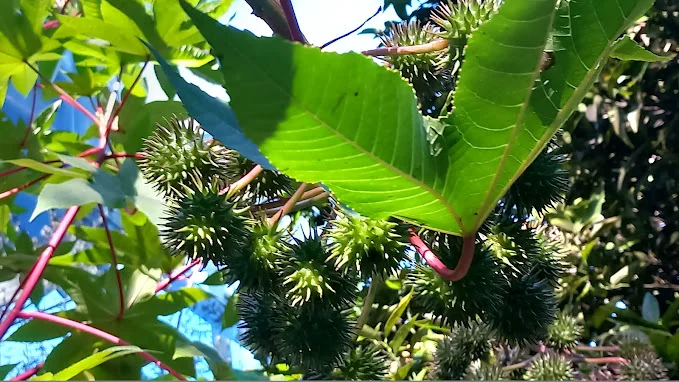

Taking advantage of a few photos I recently took, I felt encouraged to write about this Euphorbiaceae.
The Castor Bean, scientifically known as Ricinus communis, is a plant of tropical African origin. It has naturalized in many parts of the world and has been used for numerous applications, including medicinal, industrial, and cosmetic purposes. However, it is also a highly toxic plant, and I want to make it clear that nothing from this plant should be ingested, as it can cause serious and potentially fatal problems for humans. The flowers are small and not particularly striking (though they appear grouped together), and when they mature, they develop into spiny fruits that contain several seeds. It blooms in summer, but in optimal climates, it can flower almost year-round.


It is a plant with palmate or star-shaped leaves that can reach over 3 meters (and much more). There are numerous varieties ranging from green to purple, with varying heights. It behaves as an annual in climates with cold winters, while in frost-free climates, it can be considered perennial.


Due to the appearance of its leaves and its size, it is interesting in many garden designs. However, its toxicity has generated some controversies, and there have been several news reports in a local media outlet here in Palencia, where they recounted complaints from residents of a village where a bar owner had planted a "hedge" of castor beans around his establishment. The fear that a child or domestic animal might ingest it led to its removal by popular demand. In fact, due to this fear, I have seen little castor bean in public green spaces in Spain. I believe that rather than fear, we should have respect for it.


It is a plant that tolerates heat well. If our climate is cold, we can create seedbeds under cover to advance the plant since it does not withstand frost. It tolerates various soil types, as long as they do not become waterlogged but also do not dry out. It should receive sufficient rainfall or supplemental watering (although it can withstand periods of drought at the cost of not looking as lush). It appreciates nutrient-rich soils, although I read that it can help fix nutrients in the soil where it is planted.
We will use it to add verticality to a space, to delineate areas as a screen, combined with other plants. If they are red varieties, they can contrast with other species... Due to its large leaves, it can create a "tropical" feel.


Seedbed of Castor Bean


Alignment of Castor Bean to form a "screen"

Be careful not to let them grow unchecked, as their seeds disperse easily and can colonize more space or "escape" from us. It is better to collect and eliminate the seeds to ensure we do not create a problem in our area. (In the Canary Islands, it is considered invasive by the Ministry of the Environment.) Besides seed propagation, this species can also multiply vegetatively through root sprouts.
It does not have many pests; in fact, castor bean can be used in macerations, etc., to control various plant enemies.
See you next week!