Attractive and Rustic
New blog entry featuring another Scrophulariaceae, which unfortunately does not tolerate cold well. Discover the characteristics and care of _Russelia equisetiformis_, a beautiful addition to warm climate gardens.
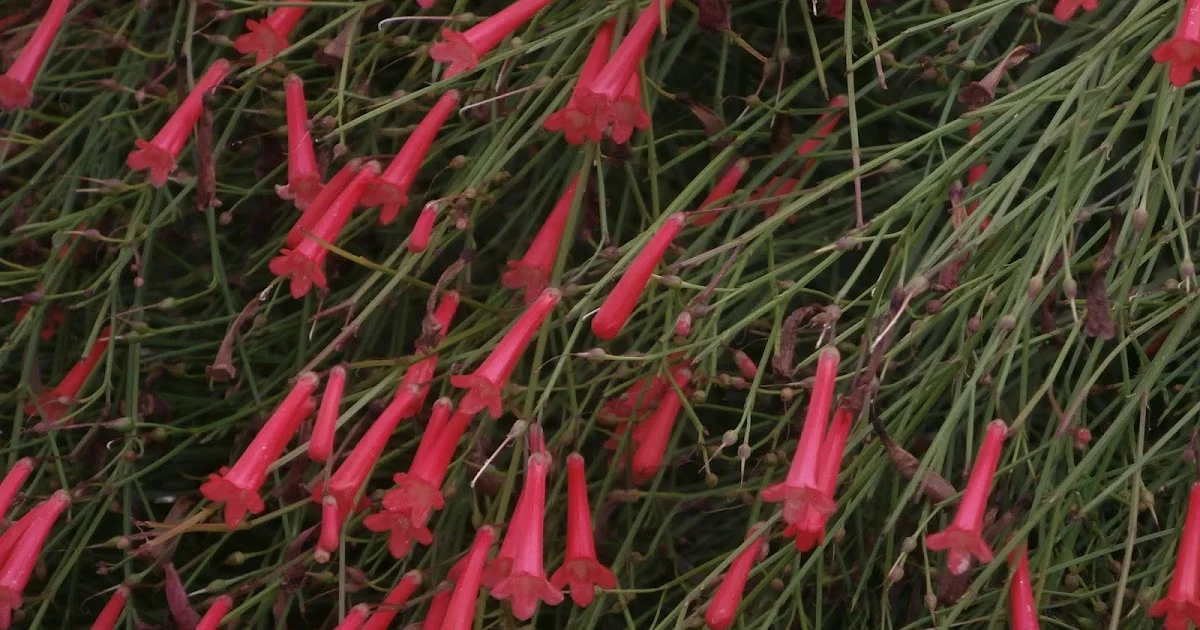

New blog entry and I bring you another Scrophulariaceae, it only has one problem: it does not tolerate cold well.
Within the genus Russelia, Russelia equisetiformis is a common sight in many gardens in warm climate areas. I have seen it in Valencia and Andalusia if that serves as a reference.
It is a Mexican plant adapted to heat. It is a compact shrub with long, hanging stems that can exceed one and a half meters in height. It forms dense clumps that acquire considerable width. The most interesting feature beyond its green foliage is its intensely red tubular flowers. Its leaves can become scale-like in some areas of the branches. In certain seasons, it may lose its foliage if the temperature drops. Its name comes from the genus dedicated to the botanist Russell, and its specific epithet refers to its similarity to an Equisetum (Horsetail), albeit with some differences.

Today's plant is resistant to any type of soil as long as it is well-drained, regardless of its pH. Due to its resistance to coastal environments, it is a candidate for many gardens near the sea, an environment that can be detrimental to other plants.
In general, this Russelia does not have problems with pests and diseases and can tolerate heat and a certain degree of drought (though it should not be stressed). As mentioned, it does not tolerate waterlogging or intense and prolonged cold. It thrives well in sunny exposures.


The interesting thing about this species is that it blooms from late spring to autumn as long as the weather permits. It can be used in a multitude of settings and situations, and it even tolerates pot cultivation so that in cold climates we can shelter it indoors.
It does not require pruning but can be trimmed if necessary, such as cutting back old, spent, or dry branches, or controlling the dimensions of the plant. We can obtain cuttings from the prunings to propagate it; another option would be through layering.