As Interesting as Unpronounceable
This week we focus on a grass that thrives in shady locations. Discover the beauty and versatility of Hakonechloa macra in your garden.

This week we focus on a grass and... what if I told you it thrives in shady locations?
Hakonechloa macra
is a grass known in gardening and increasingly used.
It seems to be named after its origin near Mount Hakone (Japan) from where it takes its name.
It is a herbaceous, rhizomatous plant, known for its slow growth, making it easy to manage if it grows too much. There are various varieties, some with green or variegated tones... long leaves, as it is a grass, with a tendency to arch. Together they form globular clumps, and depending on the variety, they can reach over 60 cm in height and width (which makes them form large clumps like big cushions that are very striking in any of their varieties). They take on yellowish tones and in autumn, their leaves change color to orange, reddish/purple... adding interest to any space.
Both for the color, the texture of its long leaves, and its arching form swayed by the wind, it is a good option for many designs, giving a natural and lush plant appearance.
It is a cold-resistant plant, tolerating very low temperatures, although the leaves may die in winter, it will sprout again in spring thanks to its underground organs. What it seems to not tolerate are strong winds, as noted in several consulted articles.

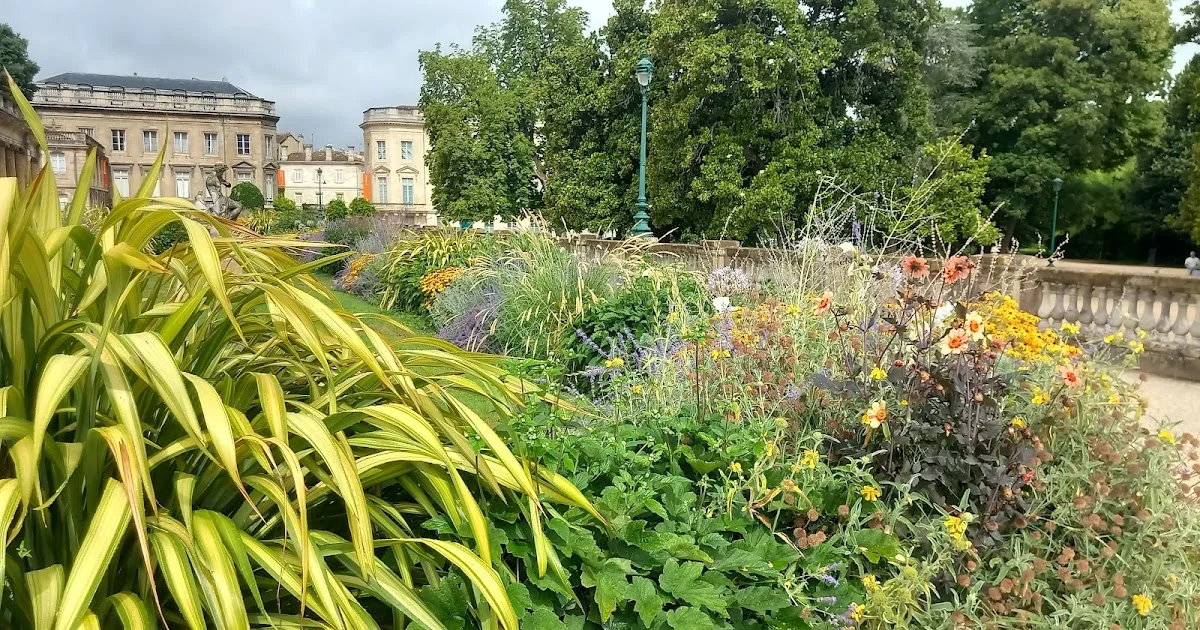
Hakonechloa macra in the foreground, in a Bordeaux garden
It prefers loose, well-drained soils, but with moisture (or irrigation) if they can be acidic even better (although it can tolerate calcareous and neutral soils).
It is a plant that prefers shady or semi-shady exposures (if you live in areas like northern Spain, it may thrive in full sun without problems; I saw it in a sunny location in Bordeaux, France, as shown in the photos).
It does not seem to be sensitive to pests and diseases, and except for a trim at the end of the cold season to remove dry vegetation (which would have protected the roots and shoots), it requires no more care than regular watering.

Hakonechloa macra in a mix
It seems ideal in large pots, in shady or semi-shady areas of the garden, under the shade of trees, combined with other shade species, in "mix borders"... Repeating some of these plants from time to time adds rhythm to the composition. Slopes, large rockeries, oriental-style gardens, in alignments or borders... I believe it can have a multitude of applications in many gardens. Its shade tolerance is definitely a plus.
Do you grow it? I don't know if here in this area of my native Castilla it will barely survive the dry summers; I think it would be better in a shaded area with irrigation. Be that as it may, I have in mind to try with some specimens... time will tell...
P.S. The variety I show you is
H. macra
"aureola"