How to Protect Your Plants from Drought: Effective Tips and Techniques
Learn how to protect your plants from drought with practical tips: watering, mulching, and choosing drought-resistant species.
5/5 - (3 votes)
Plants do not perish from heat; they perish from thirst. This distinction is crucial. As temperatures rise, water evaporates from the soil at a rate that many gardeners underestimate. The consequences include wilting leaves at noon, cracking tomatoes, and shrubs planted in spring succumbing by July. However, with the right practices—some lesser-known, like using cork plugs or watering basins—it is possible to navigate a heatwave with minimal losses. This article provides guidance, plant by plant, from immediate action to long-term strategies.
Key Takeaways
- Thick mulching is the most effective method to limit evaporation and preserve soil health during drought.
- Watering less frequently but more abundantly encourages deep root growth and naturally more resilient plants.
- Watering basins, oyas, and drip irrigation significantly reduce water loss compared to sprinkler watering.
- Fragmented cork plugs around potted plants act as a light mulch, reducing surface evaporation and lightening the substrate.
- Choosing drought-resistant species and planting at the right time remains the most sustainable solution against water stress.
Drought in the Garden: What Really Affects Plants
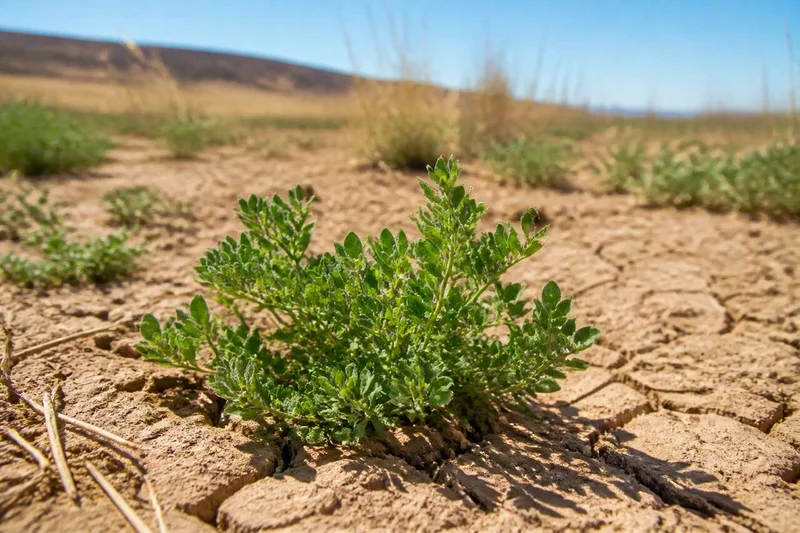
Heat and drought are two distinct phenomena, although they often occur together. In France, a drought period is officially defined as a spell without precipitation lasting fifteen consecutive days. However, in the height of summer, a plant can experience water stress well before this timeframe, especially if the soil is bare, compacted, or low in organic matter. The issue is not solely the absence of water; it is the speed at which that water disappears.
Evapotranspiration—the combination of soil evaporation and leaf transpiration—can exceed 6 to 8 mm of water per day during a heatwave. A bare soil exposed to sunlight can dry out on the surface within hours, forming an impermeable crust that paradoxically blocks infiltration during the next watering. Consequently, water runs off without reaching the roots.
Signs of water stress are often misinterpreted. A midday wilting is not necessarily alarming; it is a normal response of the plant closing its stomata to limit transpiration. However, persistent wilting in the morning, yellowing or browning leaf edges, and aborted or cracked fruits are genuine warning signs. Some plants, like zucchini, may show dramatic wilting at 2 PM but recover completely by 6 PM; thus, urgent watering is unnecessary.
Why do some plants fail despite regular watering? Several mechanisms are at play:
- Daily superficial watering keeps roots near the surface, where the soil dries out the fastest. The plant fails to develop a deep root system.
- Compacted or biologically inactive soil poorly retains water; without mycorrhizal fungi, earthworms, and organic matter, the useful reserve of the soil collapses.
- Some Mediterranean plants, like oleander, paradoxically suffer more from stagnant excess water than from moderate drought— their roots suffocate in saturated soil.
- Young plants recently planted do not yet have a sufficient root network to access water deeper in the soil.
Nevertheless, plants possess remarkable adaptation mechanisms. Some species reduce leaf area (smaller leaves, early leaf drop), while others accumulate sugars in their cells to lower their wilting point. Mediterranean plants often have tough, gray, or woolly leaves that reflect sunlight. Understanding these mechanisms helps avoid counterproductive actions, such as watering in full sun, which creates thermal shock without real benefit for the roots.
Therefore, the priority, even before discussing watering, is to address what accelerates water loss: bare soil. This is where it all begins.
The Priority: Protecting the Soil to Retain Moisture
A bare soil under 35 °C loses moisture at an alarming rate. The surface cracks, microbial life slows down, and the next drop of water—whether from rain or a watering can—runs off instead of infiltrating. Mulching is by far the most effective technique to interrupt this cycle. Numerous studies and field reports converge: a well-applied mulch significantly reduces surface evaporation, keeps the soil moist longer, and limits crust formation.
Thickness matters as much as the material. A mulch that is too thin (less than 5 cm) dries out quickly and fails to insulate effectively. Generally, 8 to 15 cm is recommended for effective organic mulching during a heatwave. The ideal composition mixes roughly half green materials (dried grass clippings, vegetable tops) and half dry materials (straw, bark, wood chips) for a carbon/nitrogen balance that nourishes the living soil without burning it.
Type of Mulch
| Mulch Type | Anti-Evaporation Efficiency | Organic Matter Contribution | Lifespan | |----------------------|-----------------------------|----------------------------|------------------| | Flax or Hemp Flakes | High | Medium | 1 season | | Wood Chips (BRF) | Very High | High (long-term) | 2 to 3 years | | Pine Bark | High | Low | 2 to 4 years | | Dried Grass Clippings| Medium | High | Few weeks | | Gravel/Sand | Medium | None | Indefinite | | Cocoa Waste | High | Medium | 1 season |
Common Mistakes to Avoid:
- Mulching on dry soil: Mulching retains existing moisture; it does not create it. Water thoroughly before applying mulch.
- Mulching against the stem: Direct contact promotes fungal diseases and slug attacks. Leave a 5 cm space around the collar.
- Using fresh clippings in thick layers: They compact, ferment, and create an impermeable barrier. Dry them beforehand or mix with dry materials.
Beyond mulching, maintaining permanent ground cover is a long-term strategy. A soil continuously covered by ground plants, green manures, or dense associations maintains a surface temperature significantly lower than that of bare soil. Under dense vegetation, the soil remains cool, biological life—earthworms, fungi, bacteria—stays active, and organic matter regenerates naturally.
Soil management also deserves rethinking. The gardening adage "a hoeing is worth two waterings" remains relevant: lightly hoeing the surface crust disrupts the capillary channels through which water rises and evaporates. A light hoeing after every rain or watering, at a depth of 2 to 3 cm, is sufficient. In contrast, deep digging in mid-summer destroys the fungal networks of living soil and exposes fresh soil to immediate evaporation—this should be strictly avoided.
Applying mature compost on the surface (without burying it) complements the strategy: it improves soil structure, increases water retention capacity, and nourishes microorganisms. A soil rich in organic matter can absorb and retain two to three times more water than impoverished soil. This is an investment that pays off during the first drought.
With a protected and living soil, the next step is to optimize how we provide water—because even good soil can be wasted through poor watering practices.
Better Watering: Frequency, Volume, and Effective Techniques
The temptation in a heatwave is to water frequently and lightly. In fact, the opposite approach is necessary. Frequent, shallow watering keeps roots in the top few centimeters of soil, where heat and evaporation are most intense. By spacing out waterings but increasing the volume, we encourage roots to reach deeper for moisture—where temperatures remain cooler and humidity stable.
The basic rule: water less often, but abundantly. For a shrub in the ground, a generous watering every two to three days during intense heat is preferable to small daily amounts. For a vegetable garden, the frequency depends on the growth stage and soil type, but the principle remains the same.
The timing of watering directly affects evaporation losses. Early morning (before 9 AM) is the ideal time: temperatures are low, winds are often absent, and leaves have time to dry before the midday heat, limiting fungal diseases. Evening (after 7 PM) is acceptable for the soil but can promote fungi on wet foliage. Watering in full sun between 11 AM and 5 PM is futile: much of the water evaporates before reaching the roots.
The method of watering is as important as the timing. Watering at the base—directly at the plant's foot without wetting the foliage—reduces losses and eliminates the risk of leaf burn. Several devices can enhance this technique:
- Watering Basins: A slight circular depression formed around the base of the plant concentrates water exactly where active roots are located. Simple, free, and remarkably effective for trees and shrubs. The basin gradually fills; it needs to be reshaped after each watering.
- Oyas: Porous clay pots buried near the roots and filled with water. Water diffuses slowly through capillarity, directly into the root zone, without surface evaporation. A 2-liter oya can supply a plant for two to four days depending on the heat.
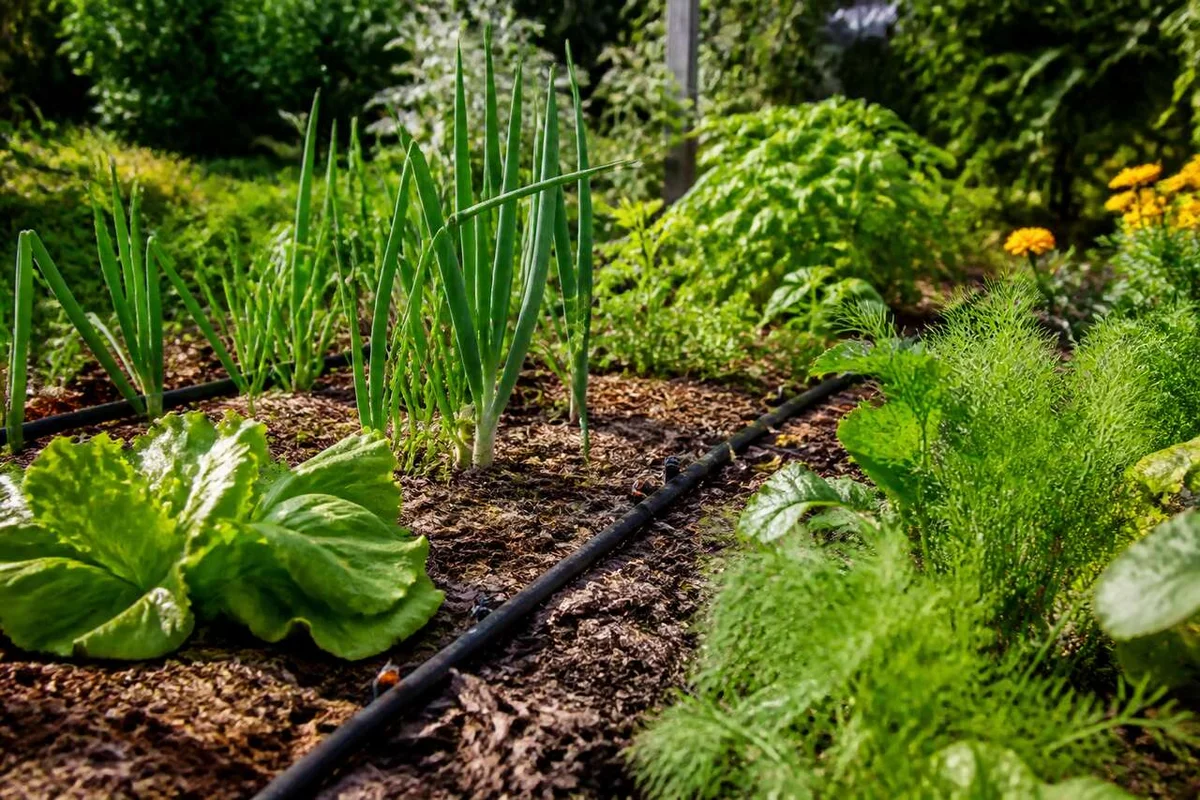
- Drip Irrigation: Ideal for vegetable gardens and flower beds, it delivers water slowly at the base of each plant, limiting waste to less than 10% compared to 40 to 50% for sprinkler watering. It can be easily programmed with a timer.
- Rainwater Harvesting: Tanks or bins placed under downspouts provide a valuable reserve. To prevent the water from heating and developing algae, it is essential to place them in the shade. A 500-liter tank can cover several weeks of watering for an average vegetable garden.