A Colorful New Zealander
This Tuesday, we talk about a very colorful plant. Often confused with grasses, belonging to the family of Cyperaceae and having a high similarity with the genus Carex, today we discuss Uncinia rubra.

This Tuesday, we talk about a very colorful plant.
Often confused with grasses, belonging to the family of Cyperaceae and having a high similarity with the genus Carex, today we discuss Uncinia rubra.
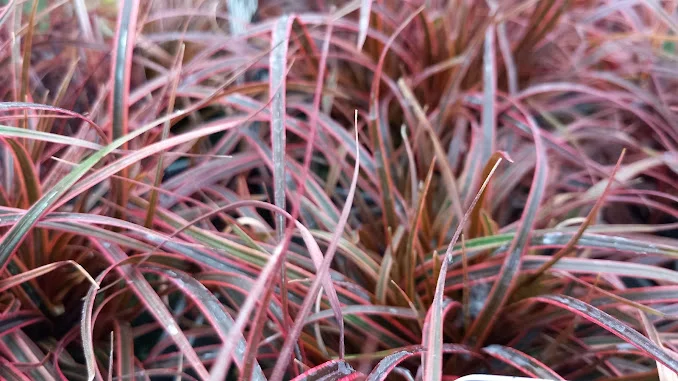
It is a plant with hard, strap-shaped leaves that curve towards the ground, giving them an arching appearance, with green and reddish tones that it maintains throughout the year, providing a very interesting look. This is why it is cultivated in gardening for its colorful contribution. It is not a large plant, not exceeding half a meter in height, forming globular clumps. It produces dark brown spike flowers in summer, but in my opinion, this is not the plant's strong point.

It is a resilient plant, tolerating exposure to sun or partial shade. It is quite hardy but prefers nutrient-rich soils with some moisture that drain well, ideally acidic soils, as it does not tolerate alkaline soils well. It seems that too much sun exposure reduces the intensity of the red and intensifies the green of the foliage.


Details of Uncinia rubra
It is a plant that does not require specific care, nor pruning, as it is sufficient to remove damaged or dead leaves to maintain the plant's appearance. Some recommend "combing" it (literally) to remove these dead leaves (as is done with some Stipa). However, many of these plants tend to have hard leaves that can cut or burn our hands, so do not forget gloves and "combs," rakes, or whatever tool you use, that are sturdy.
Regarding climate, it is resistant to considerable frost (down to -10ºC), but it is true that it is better if we do not reach these extremes. Similarly, climates with extremely hot summers may not be suitable for this species, and in such situations, a location with less direct sunlight is recommended.


It is a plant that can be placed in various spots in the garden, contrasting with other plants, or combined with other plants with reddish foliage to create a sense of harmony or unity, in compositions solely of these tones, covering surfaces... even in large pots.
We can multiply it by dividing the clump or reproducing it from seeds (keeping in mind that this way we cannot ensure the homogeneity of the produced plants either with the "mother" plant or with its siblings).
In Castilla and León, it appears timidly in some nurseries... we will see if potential customers embrace it in their patios or gardens...