The Dark Side of the Garden: Animal Traps in Plants
Explore the fascinating world of plants that trap insects in your garden. Discover how these cunning plants attract and ensnare small creatures, ensuring their survival and reproduction.
Your garden may seem like a paradise filled with beautiful blooms, busy bees collecting nectar, and butterflies fluttering by. However, beneath this serene surface lies a different reality: some plants are cunning traps for unsuspecting creatures.
Certain plants employ various strategies to attract small animals, ensnaring them in their blossoms, trapping them in narrow tubes, or immobilizing them with sticky traps. While not all of these plants consume their victims, their encounters can still be quite unpleasant for the creatures involved.
Ingenious Plant Traps
Plants cannot run away, grab, or chase insects, but they have developed remarkable methods to make animals work for them. They utilize scent, warmth, color, nectar, narrow floral spaces, sticky stems, or smooth surfaces to achieve their goals.
In some cases, the aim is to capture prey, while in others, plants temporarily hold pollinators to ensure effective pollen transfer. Crawling visitors, such as ants, may collect nectar without contributing much to pollination, leading plants to create barriers like sticky areas on their stems. This way, flying insects can still access the flower, but crawling ones find it more challenging. Carnivorous plants take this a step further by deriving nutrients from small animals.
Trap Purpose Example Kettle Trap Temporarily ensnare pollinators Aronstab, Osterluzei Sticky Trap Stop crawling insects Pechnelke Water Trap Small animals may end up in leaf axils Karde Digestive Trap Obtain nutrients Sonnentau, Schlauchpflanze
Aronstab – The Flower with an Invisible Trap
At first glance, the Aronstab appears to be a rather inconspicuous wild plant in spring, with a light flower spike nestled among its green leaves. However, for small flies, this flower acts as an invisible trap.
The plant attracts its pollinators with scent, and some Aronstab species even generate heat to enhance the fragrance. Tiny insects crawl into the flower's kettle and find themselves unable to escape due to fine hairs blocking their exit.
As the insects move around inside, they inadvertently transfer pollen. Eventually, the hairs relax, allowing the insects to leave, which is crucial for successful pollination. Unlike true carnivorous plants, the Aronstab does not digest its trapped visitors.
Osterluzei – A Clever Kettle Trap
Similar to the Aronstab, the Osterluzei employs a kettle trap. Its tubular flowers guide small flies into a tight floral space, making it significantly harder for them to exit.
Inside, fine hairs again obstruct their escape. While the insects are held captive, pollination occurs. Afterward, the flower changes, and the hairs lose their grip, allowing the insects to crawl out.
The Osterluzei exemplifies that plant traps do not always have to be deadly; they merely need to retain visitors long enough for successful pollination.
Pechnelke – Sticky Stems as a Protective Barrier
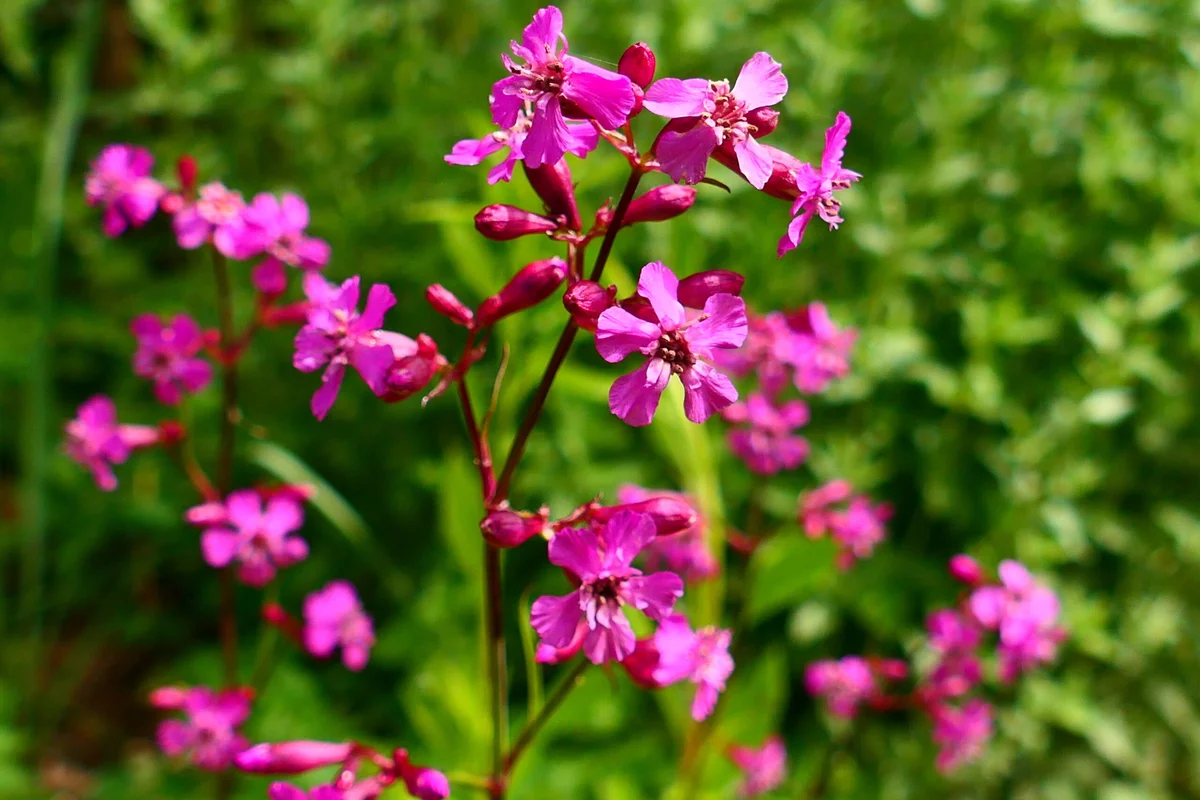
The Pechnelke does not have a trap that insects fall into; instead, its trick lies on the outside of its stem, where dark, sticky areas can ensnare small insects.
This primarily affects crawling creatures. Ants and other small visitors are prevented from climbing further up the stem. The plant benefits because not every nectar thief or nuisance can reach the flower. Thus, the sticky barrier serves as an effective blockade, identifiable by its darker zones upon closer inspection.
Karde – Small Water Basins with Risks
The Karde stands out in the garden with its tall stems and spiny flower heads. Additionally, the arrangement of its leaves creates small water basins in the leaf axils.
For tiny insects, this can pose a significant danger. Those who slip into these tight water pockets may struggle to escape. While the Karde has often been compared to carnivorous plants, it does not possess classic trapping organs like Sonnentau or Schlauchpflanzen. It remains uncertain whether it can actually derive nutrients from trapped creatures.
Carnivorous Plants – Deadly Beauties for Pots and Terraces
Now, let's turn our attention to the carnivorous plants you may have been waiting to hear about, including the Venus flytrap, Sonnentau, and Kannenpflanze. Most of these plants cannot survive outdoors in winter in our climates, making them unsuitable for garden beds. Instead, they can be kept in pots on terraces or balconies, or in greenhouses, on windowsills, or in terrariums. Some species can thrive in a moor bucket, a waterproof container filled with acidic, nutrient-poor substrate that remains perpetually moist, simulating a small bog in a pot. These plants require ample light, soft water, no fertilizer, and specialized soil.
Plant Suitable For Notes Fettkraut Windowsill, pot Catches small fungus gnats Kannenpflanze Windowsill, greenhouse Requires high humidity Schlauchpflanze Moor bucket, bog garden Sunny, acidic, permanently moist Sonnentau Moor bucket, windowsill Varies in robustness by species Venusfliegenfalle Pot, terrace, windowsill Needs plenty of light and winter dormancy
Carnivorous plants primarily capture small insects. Sonnentau uses sticky droplets, Schlauchpflanzen have deep tubes, and Kannenpflanzen feature smooth edges that cause animals to slip. The Venus flytrap closes its lobes only when its sensory hairs are triggered appropriately.
A moor bucket on the terrace can help reduce insect disturbances. However, these plants do not eliminate insects from your garden entirely, as they capture too few.
Do Not Feed Carnivorous Plants
It is captivating to observe how these plants lure animals into their traps. However, it is essential not to feed them! Avoid placing dead animals inside, as this can be overwhelming for the plant. They are quite capable of self-sustaining.
With the Venus flytrap, the temptation to trigger the traps by touching the sensory hairs is strong, but this should also be avoided, as each closure consumes energy. Repeatedly stimulating the plant without any prey can unnecessarily weaken it.
Which Animals Get Caught in Plant Traps
Small insects are the primary targets of these trapping plants. Typical victims include:
- Ants on sticky stems
- Small flies in kettle traps
- Tiny beetles in narrow flowers or tubes
- Mosquitoes on sticky leaves
- Fungus gnats on Fettkraut or Sonnentau
- Tiny aquatic organisms in water-siphon species
Thus, these plants remain manageable in the garden. A Pechnelke, a Karde, or a small moor bucket on the terrace will not disrupt the ecological balance. The key factor is the overall diversity of the garden's design.
Not All Plant Traps Fit Everywhere
Not every plant trap is suitable for every garden. Factors such as location, toxicity, or special care requirements can determine compatibility.
- Karde: sunny, rather lean spot with enough space, as it grows tall and self-seeds.
- Pechnelke: sunny, permeable, and rather lean location.
- Aronstab: should be planted only where children and pets cannot access its leaves or red berries, as it is toxic.
- Osterluzei: should be planted only with controlled spread in mind, as it is also toxic.
- Schlauchpflanze, Sonnentau, and Venusfliegenfalle: should only be cultivated in pots, moor buckets, or bog gardens, as they require nutrient-poor, acidic substrate and soft water.
- Kannenpflanze and many Fettkraut species: are better suited for windowsills, greenhouses, or protected pot cultures, where warmth, humidity, and light can be better controlled.
The Harmless Impression Can Be Deceptive
Having examined several plants with animal traps, you may now view your garden in a new light. It becomes clear that your garden is not only beautiful but can also be quite dangerous—not for you, but for the creatures that fly and crawl around.