Summer Lawn Care: Tips for Maintaining a Healthy Turf
Learn essential tips for maintaining a healthy lawn during summer heat, including mowing practices, watering techniques, and strategies to prevent damage.
During the summer months, lawns face significant challenges. High temperatures, water shortages, foot traffic, and frequent mowing can lead to thinning grass that quickly turns yellow. However, a yellowed lawn is not necessarily dead; it can often be revived with proper care. 😉
Implementing a few best practices can help minimize damage, preserve your grass throughout the summer, and allow it to regain its vitality once conditions improve. 👍🏼
Mowing Your Lawn in Summer
In the summer, mowing practices must be adjusted to avoid further stressing the grass. Contrary to popular belief, cutting grass very short does not enhance its drought resistance. In fact, a very short cut exposes the soil to sunlight, accelerating its drying out. ☀️
Should You Mow in Summer?
During periods of drought or prolonged heat, grass growth can cease entirely. The grass enters dormancy, turning yellow to conserve its resources. If you do not water it, mowing is unnecessary. It’s better to wait for rain, as the grass will begin to green up again with the first showers of late summer. 🌧️
Generally, grass growth slows in summer. Mowing should be spaced out, and cutting height should be raised. Avoid mowing during peak heat; early morning or late evening is preferable to reduce stress on the lawn.
Avoid Cutting Too Short
Once summer sets in, every inch of grass matters. Longer blades provide shade to the soil, reducing water evaporation, promoting better root development, and inhibiting weed growth. Conversely, cutting too short weakens the grass, making it more susceptible to heat stress.
In summer, it is advisable to raise the cutting height:
- 5 to 6 cm for ornamental lawns;
- 6 to 8 cm for family lawns;
- up to 8 cm in very sunny or poorly watered areas.
Additionally, consider scarifying your lawn with a scarifier, a tool that removes moss and thatch accumulated over winter. To stimulate vegetation recovery, applying maintenance fertilizer will give your lawn a significant boost.
Remember a simple rule: never remove more than one-third of the grass height in a single mowing session. This precaution helps maintain the lawn's vigor throughout the summer season.
💡 Tip: A well-maintained lawn in spring withstands heat much better. In April, once the risk of frost has passed, consider aerating your lawn. This involves perforating the soil to enhance air, water, and nutrient circulation to the roots. Better oxygenation leads to a stronger root system and a denser lawn when the heat arrives.
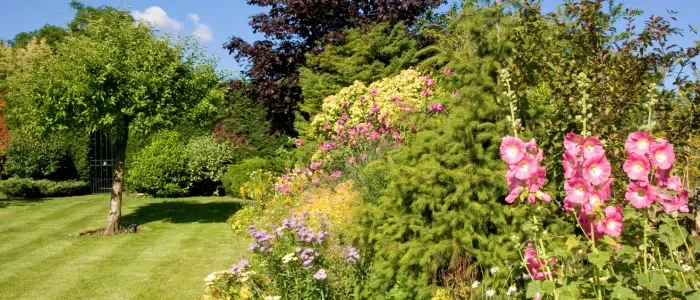
Lawn Maintenance
Beyond mowing, summer lawn care involves several essential practices to help grass endure the heat. The goal is not necessarily to maintain a perfectly green lawn throughout the season but to preserve its health and ability to recover when conditions improve. Proper watering, regular monitoring, and simple precautions can reduce stress on the lawn and prevent long-term weakening. 👍🏼
Watering Your Lawn in Summer
During the summer, proper watering can help the lawn cope with high temperatures, provided a few simple rules are followed. Poor watering practices can often be less effective and even weaken the grass.
- The first rule is to water during the coolest times of the day, ideally early in the morning or, if necessary, in the evening. Watering during the day can lead to significant evaporation before reaching the roots. Moreover, watering under intense sunlight is inefficient and wastes water. ⌚💧
- It is also better to favor deep but infrequent watering. Typically, watering once or twice a week is sufficient, depending on soil type, temperature, and any water restrictions. This method encourages deep root growth, making the grass more drought-resistant. In contrast, frequent shallow watering promotes superficial roots and increases vulnerability to water scarcity. 🧑🏼🌾
- Ensure to water slowly, using fine droplets. A high flow rate can cause runoff, preventing water from penetrating deeply into the soil. The goal is to effectively moisten the area where roots develop.
- Finally, tailor your watering system to the size of your lawn. For larger areas, an automatic sprinkler system with water-efficient sprinklers can be a convenient option, although installation may require an investment. For smaller spaces, a mobile sprinkler or a hose with a spray nozzle may suffice. In any case, consider collecting rainwater when possible: it's both economical and environmentally friendly for summer lawn care. 😉
☀️💧 If your area has water restrictions, be sure to follow local regulations before watering your lawn!‼️
Minimizing Foot Traffic
A lawn stressed by heat struggles to withstand repeated foot traffic. Limit walking on the grass, especially when it appears yellow or very dry. For heavily used gardens, it may be wise to create paths or stepping stones to protect the more sensitive areas. 👣
Avoid Fertilizing During Extreme Heat
Summer is generally not the best time to apply nitrogen-rich fertilizers. Such fertilizers promote grass growth during conditions that are not conducive to proper development. Wait until late summer or early autumn, when temperatures drop and grass growth resumes, to apply maintenance fertilizer.
Monitoring for Diseases and Weeds
Warm and humid weather can encourage certain fungal diseases, while sparse areas are easily overtaken by weeds. Regularly inspect your lawn to quickly identify any issues and intervene as necessary. 🪳

Lawn Renovation
If your lawn has suffered despite these precautions, there’s no need for immediate replacement. The best time to renovate a lawn is at the end of summer or early autumn when the soil is still warm, and rain promotes recovery. You can:
- scarify to remove thatch,
- aerate the soil if it is compacted,
- reseed bare patches with an appropriate mix,
- add fine soil and autumn fertilizer.
A lawn does not need to be perfectly green all summer to be healthy. By adjusting mowing, watering, and maintenance practices to suit climatic conditions, your lawn can better endure heat and quickly regain its vitality by the end of summer.