Transforming Garden Visions: The Art of Landscape Perspective
Discover how landscape perspective transforms garden design, making it easier for clients to visualize their future outdoor spaces through the artistry of hand-drawn illustrations.
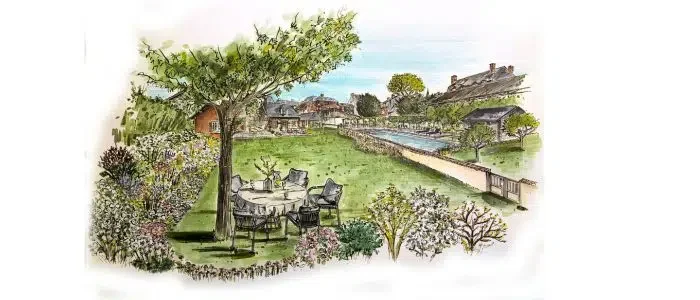
Imagining a future garden can be a daunting task for clients. Technical plans provide essential dimensions for a project but often remain abstract for those outside the field. With various elements such as plant volumes, materials, pathways, and overall ambiance to consider, visualizing the final outcome can be challenging.
In the realm of outdoor design, the ability to envision a project plays a crucial role. Clients need to comprehend the overall layout, balance of the garden, and the atmosphere that will be created in their outdoor space 🌿.
This is where landscape perspective truly shines. It transforms a technical plan into a tangible image 🏞️, allowing clients to visualize the project before it comes to life. This visualization helps clients better understand the professional's choices and how they fit into their real environment.
For professional gardeners, this tool serves as a powerful communication lever. It enhances the presentation of a garden design, reassures clients, and facilitates project approval. Behind these drawings that breathe life into future gardens lies a relatively unknown profession: that of a perspective illustrator. For over two decades, Nadine Larcher has been assisting interior and exterior design professionals in this pivotal stage. Through her hand-drawn perspectives, she aids landscapers in visually conveying their ideas, making their projects immediately understandable to clients.
Her work involves shaping spaces that do not yet exist, making the designers' visions tangible and allowing clients to step into their future gardens before the first shovel hits the ground . In a conversation with Nadine Larcher, she passionately shares insights into her profession, her journey, and her daily life as an illustrator.
A Journey Guided by Drawing
Before collaborating with landscapers and outdoor design professionals, Nadine Larcher cultivated a long-standing passion for drawing ✍️. For more than twenty years, she has immersed herself in the world of perspective, helping professionals visually represent their projects.
Trained in interior architecture, she later specialized in model-making. Her early career experiences involved creating physical models to represent projects, which honed her precise understanding of volumes and proportions and how a space can be perceived even before its realization.
However, she gradually returned to her true passion: drawing. She shifted her focus to hand-drawn perspectives, a discipline that visually translates a project based on plans, photos, or technical descriptions.
The LN Perspectives Business
Currently, Nadine Larcher operates independently through her business, LN Perspectives. She primarily collaborates with design professionals, including gardeners 🧑🏽🌾, veranda designers, pool specialists, and engineering firms. Occasionally, she also assists individuals who wish to visualize a project before it is executed.
While her early work was more centered on interior design, her scope quickly expanded to the landscape sector. Over the years, landscaping professionals have recognized her ability to bring to life projects that can sometimes be difficult for clients to envision.
This evolution was organic. The hand-drawn perspective offers a significant advantage in outdoor design: it represents architecture, volumes, and vegetation all in one image. Terraces, pools, pergolas, plantings, and pathways can be integrated into a coherent scene that showcases the project as a whole. The drawing thus becomes more than a mere illustration; it conveys the designer's intent and expresses the ambiance of a future outdoor living space. This is essential in a field where emotion and projection are paramount ⭐️.
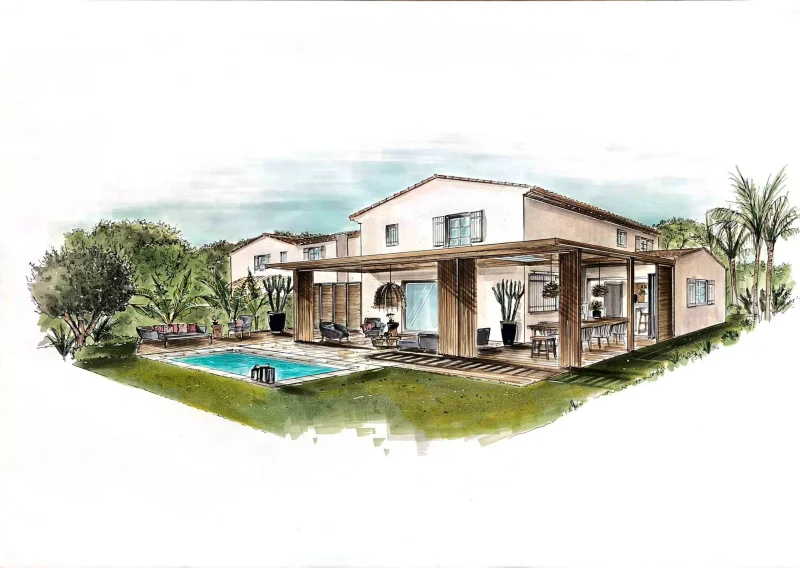
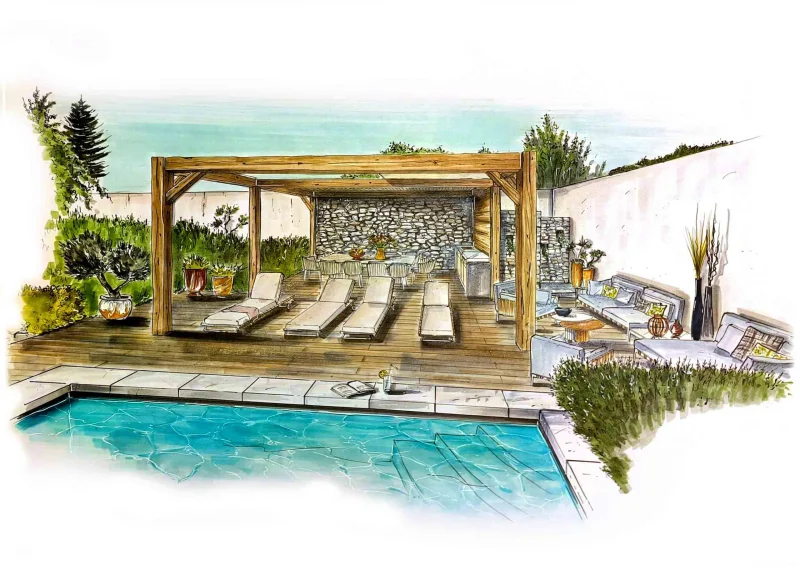
Image created by LN PERSPECTIVE: reproduction prohibited without authorization.
Her Role in Landscape Projects
In outdoor design, the conceptual phase is crucial. Before any work begins, the gardener must convey a clear vision of the future garden 🪴. Technical plans, plant placements, space organization, and material choices frame this reflection. However, these documents can be difficult for clients unfamiliar with the industry to interpret. This is where drawn perspectives become vital. Nadine Larcher's work involves translating a landscape project into a comprehensible and realistic image. Using the details provided by professionals, she creates perspectives that allow clients to visualize the proposed layout 💭.
She typically steps in when the project is well underway, with major decisions already made. The landscaper has existing plans, design sketches, or technical documents outlining the future garden's organization. As she succinctly puts it: "I usually get involved when the project is advanced enough to be presented to clients."
The perspective complements the designer's work. While the plan technically structures the project, the drawing reveals its atmosphere and volumes 🪻. This representation showcases the future garden as a cohesive whole, where pathways, terraces, plantings, structures, and design elements come together in a scene that allows for imagining the final result. Thus, the drawing becomes a powerful tool for enhancing the landscape project. Today, Nadine Larcher collaborates with numerous design professionals. While gardeners are a significant portion of her clientele, her work also extends to other outdoor design specialists, such as veranda and pool experts, as well as various engineering firms 💼.
All share a common goal: to enable their clients to quickly grasp a project that does not yet exist.
In this context, perspective plays a crucial role. It transforms a set of technical information into an accessible image, making the design immediately more concrete. As Nadine Larcher notes, "The perspective instantly provides the final rendering of the project." For landscape professionals, this representation is a valuable resource. It eases project presentations and facilitates explanations of the proposed design choices to clients. Beyond aesthetics, the drawing plays a significant role in the overall communication surrounding the project. It creates a bridge between the professional's expertise and the client's perception.

Helping Clients Visualize
For clients, envisioning a future garden from technical plans is not always straightforward. Gardeners regularly handle precise documents like plans, sections, and layout diagrams. However, for those outside the profession, these materials can often seem abstract and challenging to interpret. A garden is constructed both spatially and temporally. The volumes of plants, the organization of pathways, the balance of materials, and the overall ambiance can be tough to imagine from a simple plan 🗺️.
This is precisely where drawn perspectives become a powerful comprehension tool. By representing the project as an image, Nadine Larcher enables clients to immediately visualize the future layout. The drawing illustrates the entire project within its environment, allowing for anticipation of the future garden's atmosphere. Terraces, plantings, structures, and decorative elements come together in a coherent scene. The client no longer views a technical plan but a concrete vision of their future outdoor space. As Nadine Larcher explains, "The perspective instantly gives the final rendering of the project."
Perspective: Visualization for Project Success
This representation plays an important role in the client's decision-making process. By gaining a better understanding of the project, it becomes easier to approve certain design choices ✅. The drawing also helps to highlight the design work carried out by the gardener. The volumes, materials, and balance of plantings are clearer than they would be on a technical document. For landscape professionals, this stage often constitutes a key moment 🔑 in project presentation. The perspective facilitates discussions with clients and allows for easier explanations of the designer's intentions, while also giving clients the freedom to imagine or modify aspects of the design.
It can also help alleviate doubts. Faced with a realistic image of the future garden, clients can more easily visualize the layout in terms of its use and understand the overall coherence of the project. Emotion and experience play a significant role; perspective serves as a genuine mediation tool between the professional and the client. The drawing does not replace technical plans but complements their role by providing a more intuitive reading of the landscape project.
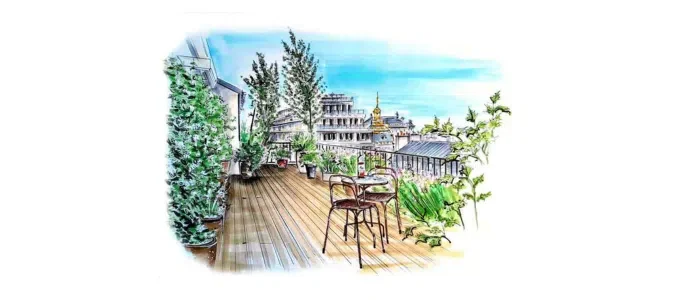
Image created by LN PERSPECTIVE: reproduction prohibited without authorization.
Field Insights
Through regular collaboration with outdoor design professionals, Nadine Larcher has developed a very concrete understanding of field needs. Her work allows her to observe 👀 how projects are presented to clients and the challenges that can arise during this conceptual phase. One of the most common observations is the difficulty clients face in visualizing concepts. Even when a project is well explained, some designs remain hard to imagine based on plans or technical descriptions.
On the ground, discussions with clients often reveal the same challenges. Even when the project is well articulated, certain designs can be abstract for those unaccustomed to reading plans. Gardeners must then find ways to convey their vision using tools that resonate immediately with clients. In these situations, perspective becomes a genuine educational support. It simplifies explaining the future garden's organization and illustrates the choices made by the professional.
Professionals often use drawings to support their arguments 🗣️ and present their projects more concretely. Clients no longer merely imagine the layout; they begin to see it as a real space, enhancing their understanding of the project.