Should You Water When Using Mulch? Understanding Plant Needs
Explore the relationship between mulching and watering in gardening, especially during hot weather. Understand how to best support your plants' water needs.
Introduction🌱
As summer heat sets in, many gardeners exploring living soil techniques often wonder: if my soil is well-mulched, do I still need to water?
This question is quite valid. In recent years, mulching has been hailed as one of the most effective practices for conserving water in the garden. This is true; a layer of mulch helps minimize moisture loss, protects soil life, and gradually enhances its fertility.
However, like many gardening practices, mulching can sometimes be oversold. Some gardeners may attribute abilities to mulch that it simply does not possess.
No, mulch does not replace rain. No, it does not ensure that plants will always have all the water they need.
During prolonged periods of intense heat, it’s crucial to understand the dynamics between soil, water, and crops to adapt practices without falling prey to misconceptions.
Mulching: A Valuable Ally
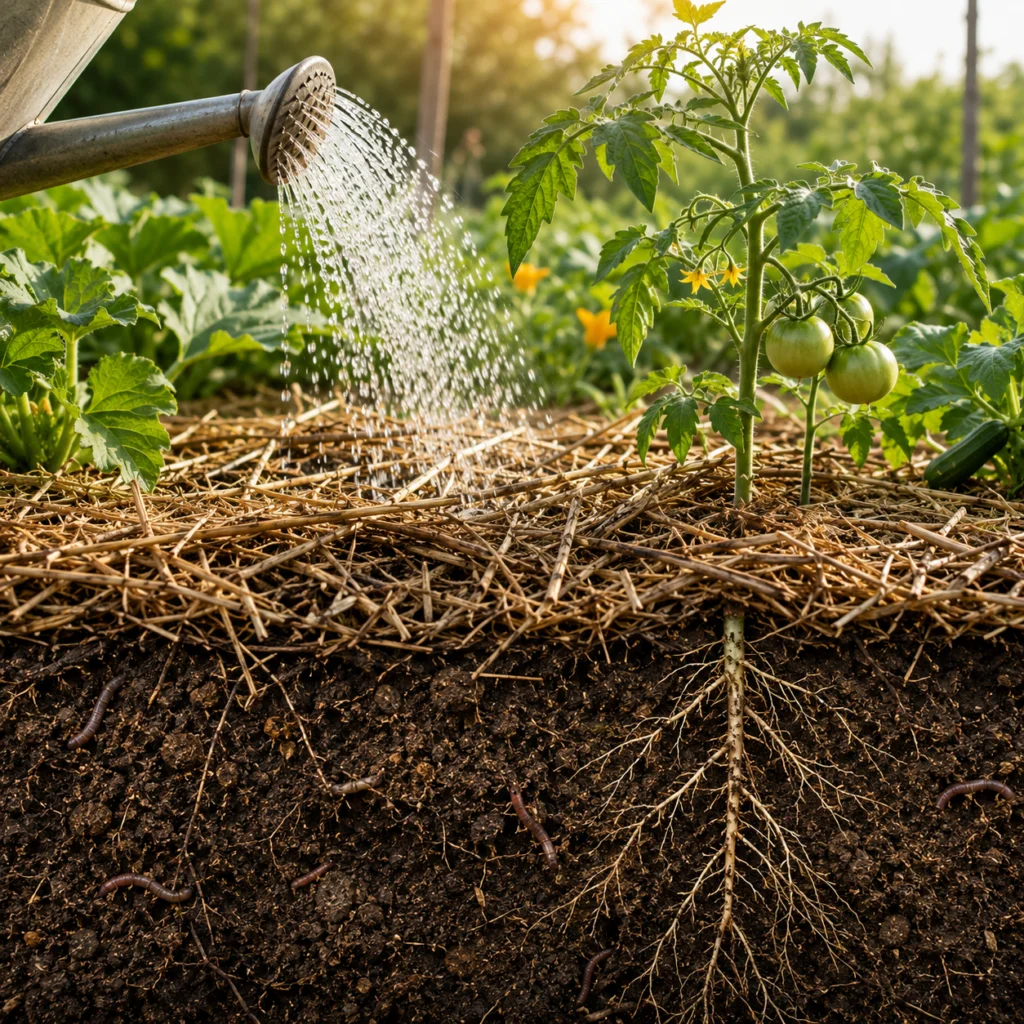
When hot weather arrives, mulch plays a vital role. By shielding the soil from direct sunlight and wind, it significantly slows down the evaporation of moisture from the top layers. This protective barrier also helps to minimize drastic temperature fluctuations that can disrupt soil biological activity.
Such protection often results in more stable moisture levels, reducing the frequency of watering. This is one of the primary reasons why mulching is central to living soil gardening approaches.
Additionally, while less visible, another key benefit of mulch is that it keeps the soil cooler and more humid, promoting the activity of earthworms, fungi, and numerous other organisms that contribute to soil structure. Over time, this biological activity enhances the soil's ability to retain water and make it accessible to plants.
However, reducing the need for watering does not mean eliminating it entirely.
Evolving Water Needs of Plants Throughout the Season
A freshly transplanted young lettuce has different water requirements compared to a tomato laden with fruit or a zucchini in full production.
As plants grow, they consume increasing amounts of water to support growth, nourish leaves, produce flowers and fruit, and regulate their temperature. This consumption spikes during hot days.
This is a phenomenon that is sometimes overlooked. A plant does not use water solely for nourishment; it continuously loses moisture through its leaves in the form of vapor. This transpiration is essential for maintaining a temperature suitable for its functioning.
As temperatures rise, this process intensifies.
Mulch helps preserve the moisture reserves in the soil for longer periods, but it cannot compensate for a prolonged absence of rain when plants begin to draw heavily on these reserves.
A Moist Surface Does Not Always Indicate Adequate Soil Hydration
This is a common mistake among gardeners new to mulching.
Upon lifting the mulch, one often finds cool soil at the surface. While this observation is reassuring, it does not always reflect the true state of water reserves.
During extended dry spells, the top layers may retain some coolness while deeper moisture diminishes. Plants with shallow root systems are typically the first to show signs of stress.
Conversely, deeply rooted crops may still access hidden reserves beneath the surface and continue to thrive.
To accurately assess soil moisture, it’s crucial to observe several centimeters below the surface. Digging with a trowel or feeling the soil’s texture can provide more insight than a mere glance under the mulch.
Plants themselves also serve as valuable indicators. Slowed growth, wilting leaves, or poorly developing fruits can signal that water is becoming limited.
Soil Texture: A Game Changer
Two mulched gardens can have vastly different water needs based on soil texture.
In clay soils rich in organic matter, water is typically stored in significant quantities. After rainfall or irrigation, these reserves remain available for a relatively long time.
In contrast, sandy soils allow water to drain quickly, leading to limited reserves. Even with effective mulching, watering needs often arise more quickly.
Loamy soils generally fall somewhere between these two extremes, but their behavior heavily depends on organic matter content and structure.
This is why watering advice from neighbors, books, or videos should always be interpreted cautiously. What works well in one garden may not be suitable just a few kilometers away.
Understanding your soil remains one of the most valuable skills for adjusting gardening practices.
When Watering Is the Best Solution
When water scarcity occurs, mulch should not be viewed as a substitute for watering but rather as a complement.
The purpose of mulching is to maximize the benefits of the water supplied. After a thorough watering or significant rainfall, mulch helps retain that moisture in the soil for plants to utilize over the following days.
In this context, watering is not a failure of mulching; it’s simply an appropriate response to the plants’ needs and current conditions.
When watering becomes necessary, it’s generally better to provide enough water to saturate the soil deeply rather than applying multiple shallow doses. This encourages roots to explore a larger soil volume, enhancing the plants’ resilience during heat waves.
The goal is not to water frequently but to water wisely.
Conclusion
Mulching remains one of the best tools for gardeners to preserve soil moisture and reduce water loss during summer. It protects the soil surface, supports biological activity, and gradually improves the soil's ability to cope with dry periods.
However, it does not transform the garden into a self-sufficient system.
Plants continue to grow, produce, transpire, and consume water. As temperatures rise and rainfall becomes scarce, their needs can exceed the available reserves in the soil, even when it is mulched.
Rather than questioning whether to mulch or water, it is more accurate to consider these two practices as complementary. Mulching aids in water conservation, while watering replenishes reserves when necessary.
As is often the case in gardening, the best approach is not to apply a one-size-fits-all rule but to observe your soil, plants, and current conditions to make the most informed decisions.