Review of the Rain Bird TRU8IW Wi-Fi Controller: Smart Irrigation for 8 Zones
Explore the Rain Bird TRU8IW, an indoor Wi-Fi irrigation timer designed for managing up to 8 zones. Learn about its features, installation, and user feedback.
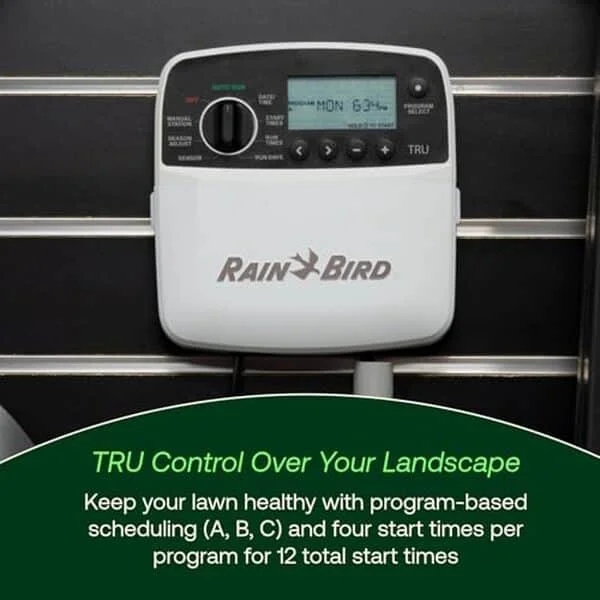
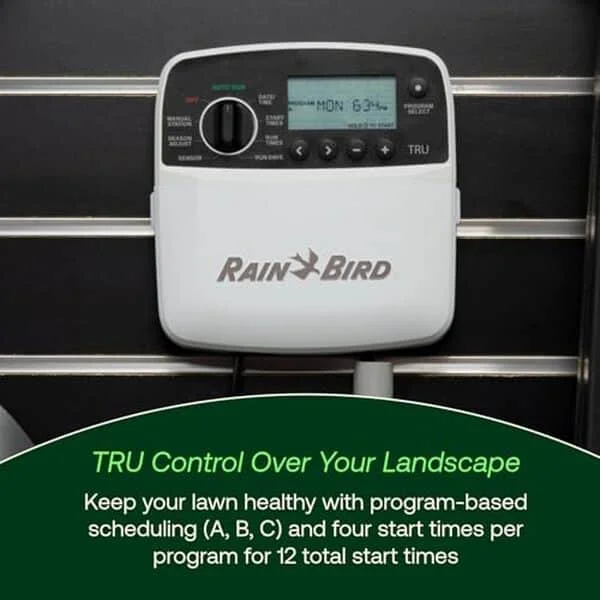
The Rain Bird TRU8IW is an indoor irrigation timer equipped with Wi-Fi capabilities, designed to manage up to eight zones. This device aims to transition residential installations from basic local programming to a more flexible, program-driven management system.
With an average rating of 4.4 out of 5, expectations are clear: users seek a straightforward setup, stable programming, and reliable control of irrigation stations, all while keeping daily watering routines uncomplicated.
Who is the TRU8IW Suitable For?
This timer is tailored for homes with multiple irrigation circuits, including front and back gardens, flower beds, hedges, drip systems, or lawns, all separated by valves. With its capacity to manage eight zones, it adequately covers most domestic configurations without necessitating a shift to more complex controllers designed for larger properties.
Designed for indoor installation, it is best suited for garages, utility rooms, or laundry areas, ideally located near electrical outlets and valve wiring. If your setup includes only one or two zones, the eight-station format may seem excessive; however, it allows room for future expansion.
Programming and Wi-Fi: Enhanced Daily Management
The TRU8IW is positioned as a smart controller that utilizes Wi-Fi, focusing on program logic rather than simple mechanical timers. This approach allows for more precise adjustments to watering schedules (days, durations, sequences by zone) while maintaining overall coherence: preventing two high-demand zones from operating simultaneously or distributing watering to minimize runoff.
In daily use, the anticipated benefit lies in the ease of adjustments: modifying a program, temporarily suspending it, or adapting durations according to the season can all be done without needing to return to the main unit. For households that frequently leave home, this flexibility can help avoid unnecessary watering and lapses in care.
Indoor Installation and Box Contents: What to Consider
The manufacturer provides the essentials: the timer, a 1.8-meter power cable, a transformer, and a user manual. It is worth noting that French documentation is not guaranteed, which may complicate initial setup for some users, although the interface and physical indicators are generally accessible.
The indoor format also requires a clean, dry location and organized valve wiring. In older installations, it may be necessary to re-label wires by zone to avoid miswiring during connection. The 1.8-meter cable provides adequate length, but consideration of the placement is necessary if the outlet is far away.
Reliability and Anticipated Limitations
A connected timer relies on two key elements: power supply and the quality of the Wi-Fi network at the installation site. In a garage that is far from the router or behind load-bearing walls, connection stability can become a concern, as it directly affects remote management comfort. In such cases, a Wi-Fi repeater or mesh network may be necessary for a seamless experience.
Another practical limitation is that the usage remains focused on zone-based programmed irrigation. If you are looking for an advanced automation solution integrated into a complex smart home ecosystem, it is advisable to verify compatibility with your control habits beforehand to avoid a technically sound but underutilized solution.
Value for Money: Does the Interest Depend on the Number of Zones?
The value of this product can be assessed on two levels: capacity (8 zones) and time saved in program management. The more segmented your installation is, the more significant the advantages become compared to basic solutions, as centralized programming minimizes errors and simplifies seasonal adjustments.
Conversely, for very simple installations, the investment is justified primarily if you value Wi-Fi control and the ability to modify programs without physical presence. In a long-term perspective, the potential for growth (available zones) may also be a factor if you plan to add more irrigation lines.
Test Summary
Advantages
- Wi-Fi control and programming logic tailored for residential use
- Up to 8 zones to cover most multi-circuit installations
- Designed for indoor installation, convenient for a technical room
- Complete package with transformer and 1.8-meter power cable
- Good overall rating (4.4/5)
Disadvantages
– User manual in French not guaranteed, which may slow down the initial setup – Connected comfort depends on the quality of Wi-Fi at the installation location – May be oversized if you only have 1 to 2 zones
Technical Specifications
- Indoor irrigation timer with smart Wi-Fi module
- Program-based control
- Capacity: 8 zones/stations
- Brand: Rain Bird
- Model: TRU8IW
- Manufacturer Part Number: TRU8IW
- UPC: 077985094157
- ASIN: B0DV8X37G7
- Included Components: timer, 1.8-meter power cable, transformer, manual
- Documentation: French not guaranteed
- Counting Unit: 1 unit
- Average Customer Rating: 4.4/5
Editorial Rating 16/20
- Ease of installation (indoor):
- Flexibility of programming:
- Remote control and Wi-Fi experience:
- Suitability for multi-zone installations:
- Clarity of documentation:
- Value for money based on need:
User Ratings 4.4/5
The product holds a rating of 4.4 from 131 users, highlighting that the key decision often revolves around the flexibility of Wi-Fi control versus the real constraints of network coverage in the technical room.

Personal Opinion on the Product
With an average rating of 4.4/5, the TRU8IW is generally seen as a robust solution for organizing multi-zone irrigation, with expectations for practical Wi-Fi control. The main point of caution remains the ease of use, especially if documentation is not available in French, and the typical dependency on a stable connection at the installation site.
When comparing options, keep in mind that the value of this model significantly increases as irrigation is segmented across multiple zones.