Exoskeletons in Landscaping: A New Support for Gardeners?
With the rise of exoskeletons in landscaping, professionals are finding innovative ways to reduce physical strain and enhance their work efficiency. This article explores the benefits and limitations of using exoskeletons like the Exhauss HPXO 25.
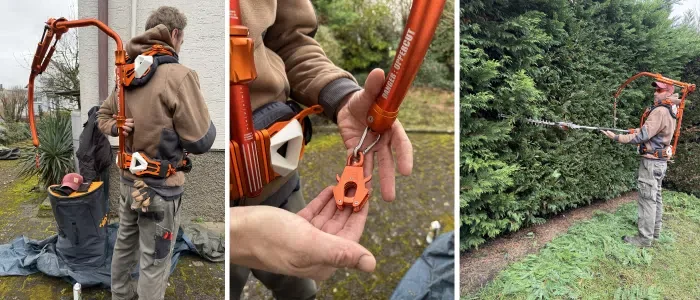
In the landscaping profession, musculoskeletal disorders (MSDs) pose a significant risk due to repetitive physical efforts. To safeguard their health and extend their careers, an increasing number of professionals are turning to exoskeletons. Designed to reduce fatigue, alleviate joint stress, and distribute effort more evenly, these devices are gradually becoming a common sight on job sites. 💪 Through the insights of Jimmy Lévêque, manager of Evo Garden and user of the Exhauss HPXO 25, we explore the tangible benefits and limitations of this innovative solution for landscapers. 🌱
Exoskeletons: Purpose, Benefits, and Applications
What is an Exoskeleton?
An exoskeleton (or assistive harness) is a mechanical device worn on the body that decreases physical strain during repetitive tasks, such as lifting arms, carrying tools, stabilizing weights, or maintaining awkward postures. Originally designed for the film industry, these devices are now being adapted for landscape gardeners. Unlike motorized models, passive exoskeletons like the Exhauss HPXO 25 operate without batteries, utilizing a system of joints, springs, or compensatory arms. ⚙️
What Are Their Functions?
In landscaping, these tools provide tangible assistance for:
- Supporting arms during extended hedge trimming ✂️
- Reducing spinal pressure during heavy lifting
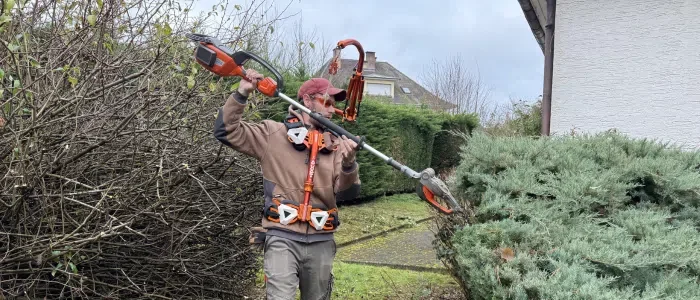
- Assisting with the use of heavy or pole-mounted tools
- Minimizing fatigue during repetitive tasks on-site 🌿
When Technology Eases the Gardener's Task
The exoskeleton does not replace the gardener's movements; instead, it intelligently alleviates them. Practically, this can translate to several kilograms of support with each motion. For professionals who regularly handle machines weighing between 5 to 7 kg or more, such assistance becomes a crucial preventive measure. 🛠️
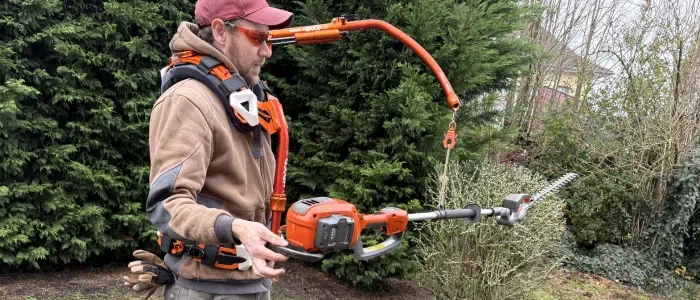
The model used by Jimmy Lévêque features a compensatory arm capable of supporting up to 20 kg while only exerting a perceived weight of 400 g. This does not eliminate weight but significantly reduces muscular effort, allowing gardeners to work more efficiently, accurately, and with less risk of chronic pain. The advantages become immediately apparent during high hedge trimming or long cutting sessions.
Profile and Motivation of Jimmy Lévêque
Jimmy Lévêque honed his skills in the public sector, where he worked for several years before launching his own business. In 2019, he founded Evo Garden, aiming to provide more flexible, high-quality landscaping and maintenance services tailored to client needs. Since then, he has been actively involved in various projects that heavily engage a gardener's body, including trimming, maintenance, and lifting tasks.
Alleviating Strain with an Exoskeleton
Like many in his field, he has felt the cumulative effects of time on his body: shoulder tension, arm fatigue, and muscle discomfort by the end of the day. While not unusual in this profession, these symptoms prompted him to seek sustainable solutions.
It was in this context that he decided to try an exoskeleton. His motivation stemmed not from trends or marketing hype, but from a genuine need for physical relief.
His Choice: The Exhauss HPXO 25
He approached the decision thoughtfully, first engaging with fellow professional gardeners on social media to gather their experiences and understand the differences between models. To form his own opinion, he traveled over two hours to Strasbourg to test a device in real conditions. After receiving an initial model that did not meet his expectations (which he promptly returned), he ultimately chose the Exhauss HPXO 25, convinced it was best suited for his daily activities.
Feedback on the Exhauss HPXO 25
Initial experiences confirmed his instincts: although the device requires some adjustments at first, movements quickly feel more natural. "You can really feel the support. You can endure longer, and importantly, you tire less quickly," he explains. This immediate feedback marks a turning point: the exoskeleton is far from a gimmick; it is a genuine ergonomic aid.
An Exoskeleton Designed for Repetitive Tasks
Jimmy Lévêque selected the EXHAUSS HPXO 25, specifically engineered for repeated efforts and overhead loads. This device provides assistance equivalent to 20 kg while transmitting only 400 g of actual effort to the user’s body. 🔧 It is not a futuristic apparatus: it has no motors or batteries; instead, it employs a clever articulated system that absorbs, distributes, and balances the forces exerted by tools or the gardener's arms. The price ranges from €3600 to €4000 depending on the version, a significant investment, but one that the landscape gardener considers reasonable given the potential health benefits and the effort-to-result ratio. ⚖️
Installation, Adjustments, and Familiarization
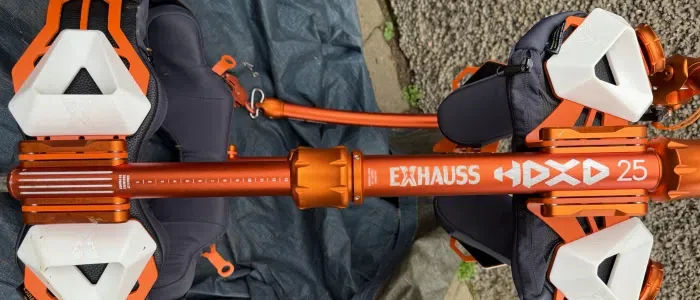
The Exhauss HPXO 25 is an articulated model that requires proper installation to be truly effective. The gardener emphasizes a critical point: adjustment is key. 🔧
The device can be adjusted in several areas:
- The waist belt, which must be securely fastened
- The chest straps
- The rear articulation system
- The compensatory arm, adjustable in height and tension
Necessary Adjustments at the Start
Initially, this may seem overwhelming 🧩, but he elaborates: "The adjustments take a few minutes, but once you find your settings, it goes quickly. And what’s convenient is that there are numbered indicators. You know exactly at which setting you feel comfortable."
This means each user must tailor their exoskeleton to their own physique, making the device quite personal. It is challenging to lend it to other professionals of different sizes without readjusting, which could take time on a job site.
Once configured, the exoskeleton becomes intuitive 🎯:
- Movements remain natural
- The assisted arm follows the gestures
- It can be donned and removed quickly
He notes that achieving the perfect adjustment does not happen on the first day; it typically takes between three to five uses to find one’s “ideal position.”
Field Feedback: Sensations & Results
The feedback is candid, direct, and very concrete. From the first uses, he experiences genuine relief, particularly during trimming tasks that heavily engage the arms and back. 💪
Notable effects include:
- Reduced pressure on the spine
- Decreased tension in the shoulders
- Less muscular strain
- Improved tool stability
- A significant reduction in end-of-day fatigue, allowing for more energy to clean up and organize after trimming
It is not miraculous; it does not heal injuries. However, it alters the perception of effort. It feels like removing an invisible weight. He also emphasizes that the exoskeleton is a true asset for handling pole-mounted hedge trimmers for hours, making the machine feel much lighter and requiring less muscular tension to stabilize.
Concrete Advantages Observed for Gardeners
With multiple uses, the benefits become clear and measurable 🌱.
Among the most significant points:
- Significantly improved comfort during long trimming sessions
- Enhanced endurance, allowing for consistent quality from the first to the last meter, and still having energy left for cleanup or adjustments after trimming.
- Fewer shocks and vibrations transmitted to the body
- Reduced nerve fatigue, often linked to compensatory movements
The assistance system enables him to work longer without experiencing the usual exhaustion from physically demanding tasks. The exoskeleton does not replace human strength; it optimizes effort. This is an important distinction, but one that profoundly changes working conditions.
Limitations, Constraints, and Areas for Improvement
No innovation is flawless, and the gardener remains clear-eyed about this 🧐.
Identified limitations include:
- A necessary learning curve Certain movements need to be rethought. The exoskeleton encourages a new working style, emphasizing leg bending rather than bending from the back. Ergonomically sound, but “not natural at first.”
- Different posture depending on the tools For some very close tasks, such as trimming the sides of hedges, the articulated arm can slightly limit movement ease.
- A physical presence, albeit light It is not heavy, but it is not invisible either.
- A significant investment Between €3600 and €4000, depending on the model.
- A very personal tool. Given the precise adjustments, it is not easy to lend the device, especially if users have different body types.
Who Is This Exoskeleton For? Which Projects?
The Exhauss HPXO 25 particularly suits:
- Landscapers engaged in long trimming sessions
- Professionals frequently working at height
- Individuals experiencing recurring arm or back pain
- Those handling heavy or vibrating tools
It is less suitable for very dynamic job sites requiring rapid freedom of movement. He reminds us that it is not a “universal” device but a specialized tool, ideal for certain tasks, less effective for others.
Conclusion: Innovating for Longevity. Jimmy Lévêque’s testimony confirms that the exoskeleton is not a passing trend. It represents a logical evolution in the sector 🌍. With the potential for decreasing prices, more compact models, enhanced joints, and increasingly precise ergonomics, this tool could become a standard piece of equipment in the coming years. The Exhauss HPXO 25 is not magical; it marks a significant advancement for landscapers. By alleviating loads, improving posture, and lightening movements, it becomes a true ally in daily work 🌿. Jimmy Lévêque’s sincere and concrete feedback illustrates that an exoskeleton can genuinely transform work methods, provided one is willing to embrace the learning phase and aim for the long term. In a profession where the body is the primary tool, equipping oneself for longevity is essential. Innovation is not a gimmick; it is a new form of prevention, more necessary than ever.