Creating a Forest Garden: The Best Plants for Your Green Sanctuary
Explore the concept of forest gardening, a sustainable approach to growing fruits, herbs, and vegetables in harmony with nature. Learn about its benefits, principles, and how to implement it in any garden size.
Gardens come in many forms, from meticulously trimmed boxwood hedges and pristine lawns to those where nature seems to reign supreme. The latter has always captivated me.
When I first encountered the concept of a forest garden years ago, I was initially doubtful. The idea of growing fruit trees, berry bushes, herbs, vegetables, and ground covers together seemed more like a chaotic patch of land than a well-planned garden.
However, a forest garden is anything but unkempt. It represents a carefully designed system that mimics the natural processes of a forest. In this setting, plants thrive alongside one another, each fulfilling its role. Tall trees provide shade while deep-rooted plants aerate the soil. Ground covers protect the earth from drying out, and herbs attract a myriad of beneficial insects.
Over time, this arrangement evolves into a small ecosystem that becomes increasingly stable and yields fruits, berries, herbs, and vegetables. The best part? As the forest garden matures, it requires less maintenance.
You might wonder if such a garden can be established in a typical home garden.
The answer is a resounding yes.
You don’t need a sprawling farm or even half a hectare of land. Even on a small plot, creating a forest garden is surprisingly feasible. The key is to view your garden not as a collection of individual beds but as a cohesive living entity.
This article aims to guide you through that process.
What is a Forest Garden?
When people hear the term forest garden, many look puzzled. Most associate forests with tall trees and dense undergrowth, not with vegetables or fruits.
Yet, the principle behind a forest garden is both simple and ingenious.
Instead of strictly separating plants into individual beds, you align your design with nature. Observe a healthy deciduous forest: it is home to not just one species of plant but a variety of layers, including large trees, smaller shrubs, ferns, herbs, mosses, and fungi. Each plant occupies the space that suits it best.
You can apply this principle to your garden.
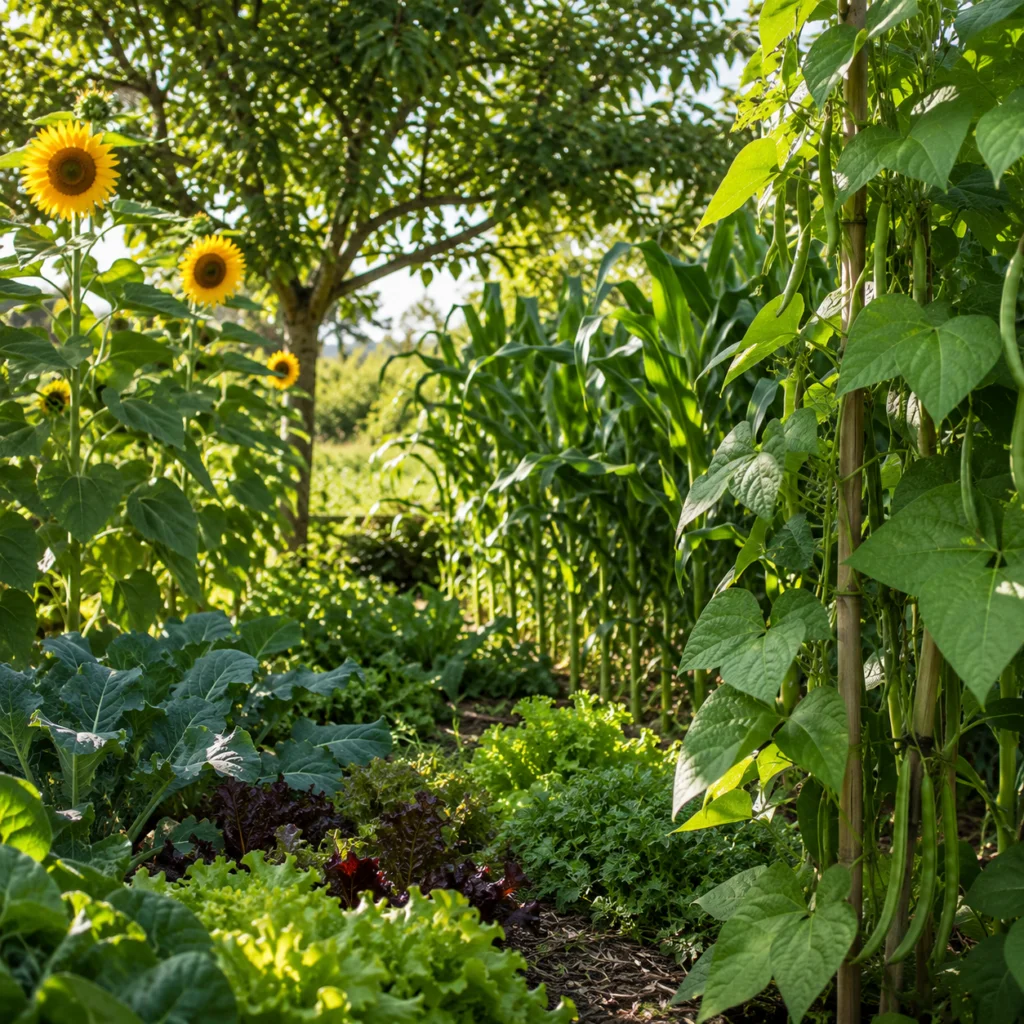
Instead of just oaks or beeches, you could grow apple, pear, or chestnut trees. Beneath them, you might cultivate currants, blueberries, or hazelnuts. Between the shrubs, plants like wild garlic, woodruff, or lemon balm can thrive. Ground covers like wild strawberries keep the soil moist, while climbing plants such as grapes or kiwis take advantage of vertical space without competing for ground.
This creates an edible landscape where nearly every plant serves a purpose.
The Origin of Forest Gardens
The concept is not new. For centuries, people across the globe have cultivated gardens based on this principle. Forest gardens or food forests emerged in Asia, Africa, and Central America long before the term gained traction in Europe.
In our regions, similar systems existed as well. Traditional cottage gardens often featured fruit trees, berry bushes, herbs, and vegetables growing closely together, though they were not labeled as forest gardens.
In recent decades, this concept has gained popularity through permaculture, and today, forest gardens are recognized as one of the most sustainable forms of gardening.
Permaculture vs. Forest Garden: What’s the Difference?
Many people use these terms interchangeably, but this is not entirely accurate.
Permaculture is a comprehensive planning methodology aimed at mimicking natural cycles and utilizing resources efficiently.
In contrast, a forest garden is a specific type of garden design within the framework of permaculture. It is structured to reflect the layout of a natural forest, leveraging its advantages for growing vegetables and fruits.
You can create a forest garden following permaculture principles, but it is not a strict requirement.
Why Do Forest Gardens Work So Well?
A healthy forest thrives without tilling, synthetic fertilizers, or daily watering.
Why is that?
Because every plant has its role.
Fallen leaves create a new layer of humus each year. Earthworms pull organic material into the soil. Fungi and microorganisms decompose dead plant matter, recycling nutrients.
You can harness this interplay in your garden too.
The more diverse your plant selection, the more resilient your system becomes.
Advantages of a Forest Garden in Your Home Garden
After years of gardening, I have experimented with countless methods—raised beds, traditional vegetable plots, companion planting, and various forms of permaculture. Many gardeners can relate. However, a forest garden stands out as it requires significantly less maintenance over time.
Less Work Over Time
This may sound almost too good to be true.
Yet, the care required changes significantly as time goes on.
In traditional vegetable gardens, you prepare the soil each spring, weed regularly, and often water. In a forest garden, much of this work is handled by nature.
The soil is protected year-round by leaves and ground covers, leading to less unwanted growth and slower drying during hot summers.
Increased Biodiversity
A forest garden is beneficial not only to you.
Within a few years of establishment, you will notice an increase in wildlife visiting your garden.
Wild bees find flowers nearly year-round. Butterflies discover new food sources. Birds nest in the shrubs, and hedgehogs find shelter among the leaves and dead wood.
Where diverse animal species thrive, a stable ecosystem emerges.
A Healthy Soil
Soil is the heart of every garden.
Unfortunately, many gardeners treat it merely as a planting medium.
In a forest garden, this perspective shifts dramatically.
The earth is not constantly disturbed. Instead, it remains largely undisturbed. Earthworms, fungi, and countless microorganisms do the work.
Each autumn, new leaves accumulate, slowly decomposing into valuable humus. Erosion is minimized.
After a few years, the soil feels loose, dark, and crumbly—exactly how good garden soil should be.
Resilience During Hot Summers
Recent years have shown just how dry our summers can become.
A forest garden adapts remarkably well to such conditions.
The various plant layers shade the ground, reducing evaporation and retaining moisture much longer.
On particularly hot days in July, the temperature difference between an open vegetable bed and a well-established forest garden can be several degrees.
Continuous Harvests from Spring to Winter
Another advantage lies in the variety.
While traditional vegetable gardens often yield produce for just a few months, a forest garden can provide edible options nearly year-round.
In spring, the season kicks off with wild garlic and other herbs. Soon after, strawberries, currants, and gooseberries follow. Summer brings cherries, plums, and raspberries, while autumn yields apples, pears, hazelnuts, and chestnuts. Even in winter, with some planning, you can harvest kale, Jerusalem artichokes, or salsify.
This natural succession ensures your garden supplies food for many months—often with surprisingly little effort.
Can You Create a Forest Garden in a Small Space?
A common question arises:
"Is a forest garden only suitable for large properties?"
No, absolutely not.
While larger plots can accommodate more plants, the fundamental principle works remarkably well on smaller areas. What matters is not the size of your garden but how cleverly you utilize the available space.
In a traditional vegetable garden, plants typically grow side by side. A forest garden, however, also incorporates height. Just like in a forest, various layers emerge, optimizing the available space.
Imagine an apple tree. Beneath its canopy, currants can flourish. Between them, you might plant wild garlic, woodruff, and chives. Ground covers like wild strawberries blanket the soil while a vine climbs the trunk or a pergola. Thus, five or six different crops can thrive in the same area without hindering one another.
This is the significant distinction from a conventional garden.
Forest Gardens on 100 to 300 Square Meters
Many hobby gardeners have plots of this size, making it an excellent area for a small forest garden.
When starting, don’t aim to cram in as many trees as possible. Often, less is more.
I recommend beginning with two or three fruit trees, alongside some berry bushes, perennial herbs, and edible ground covers. After just a few years, this can evolve into a remarkably diverse garden.
A common mistake is planting too closely. Trees grow slowly but will eventually develop substantial canopies. Providing them with ample space will save you considerable work later on.
Can You Implement a Forest Garden in a Row House Garden?
Yes, this is also possible.
Narrow plots particularly benefit from thoughtful planting.
Slim columnar fruit trees or compact fruit varieties require little space. Climbing plants like grapes or mini-kiwis can utilize fences or pergolas as additional planting areas.
Berry bushes can easily be planted along property lines, where plants like woodruff, wild garlic, or wild strawberries thrive beneath.
Even if your garden is only 80 square meters, you can implement many elements of a forest garden.
Does a Forest Garden Have to Look Wild?
This is perhaps the biggest misconception.
Many envision a forest garden as an overgrown plot.
In reality, you can design a forest garden to look very neat.
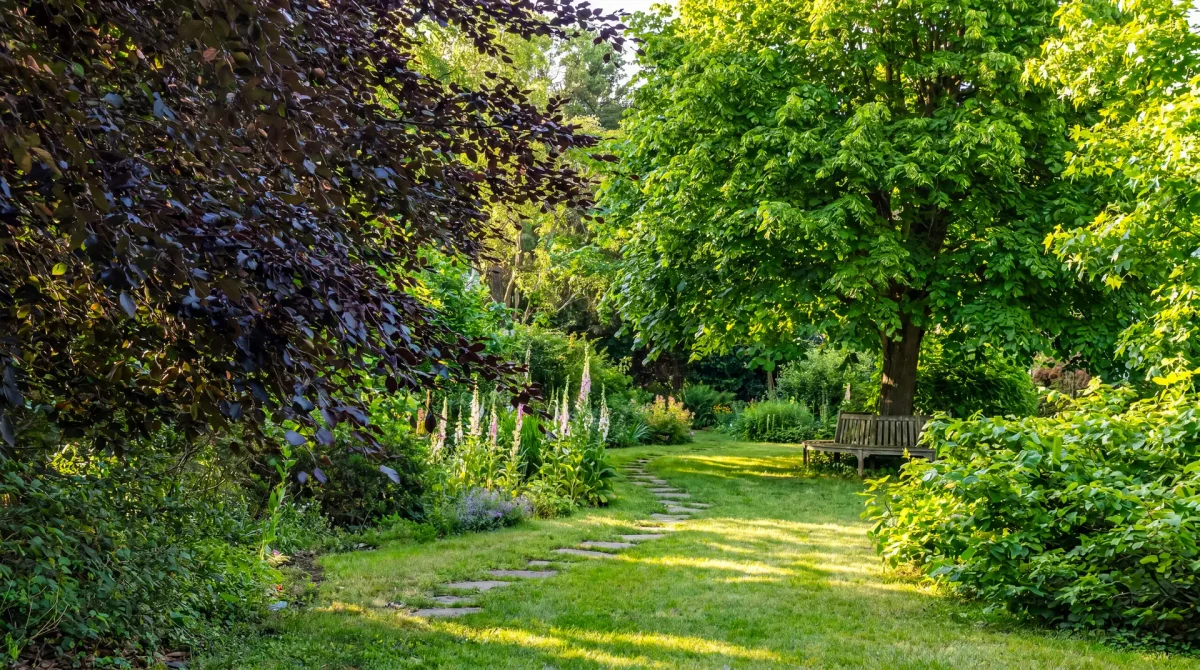
Curved pathways, well-maintained mulch areas, neatly pruned fruit trees, and intentionally arranged plant groups can create a structured appearance.
While nature can play a role, it doesn’t take over.
This balanced approach is what I personally find most appealing.
The Seven Layers of a Forest Garden Explained Simply
When planning a forest garden, always think in terms of layers rather than individual plants.
A forest thrives because different plants exploit various zones. Tall trees capture sunlight while shrubs, herbs, and ground covers grow below. These distinct vegetation layers work together and complement each other.
You can adopt this principle in your garden.
The Upper Tree Layer
This layer forms the canopy of the forest garden.
Here, larger fruit or nut trees such as apple, pear, cherry, chestnut, and walnut (if space permits) grow.
These trees provide shade, improve the microclimate, and yield produce for decades.
I recommend choosing robust, regional fruit varieties. They typically adapt better to our climate and are often more resistant to diseases.
The Second Tree Layer
Not every tree needs to be colossal.
Below the upper layer, smaller trees can thrive. Varieties such as dwarf apples or pears can fit perfectly in a compact garden.
The Shrub Layer
In this layer, berry bushes such as currants, blueberries, and gooseberries flourish, providing delicious fruit and attracting wildlife.
The Herb Layer
Herbs like wild garlic, woodruff, and other perennial herbs thrive in the shade of the upper layers, enriching the garden with flavors and attracting beneficial insects.
The Ground Cover Layer
This layer consists of low-growing plants that protect the soil and retain moisture. Wild strawberries and other ground covers are perfect choices.
The Climbing Layer
Climbing plants such as grapes and kiwis can utilize vertical space, growing up trees or trellises without taking up precious ground area.
The Fungi Layer
Finally, the fungi layer is often overlooked but crucial for soil health. Fungi break down organic material and help recycle nutrients, contributing to the overall ecosystem.
By understanding these layers, you can create a thriving forest garden that embraces the principles of nature while providing a bountiful harvest.