Choosing the Right Pool Cover: Sliding Roofs, Roller Covers, or Domes
Explore the benefits of pool covers, including sliding roofs, roller covers, and domes. Learn how to choose the right system for your garden and family needs.
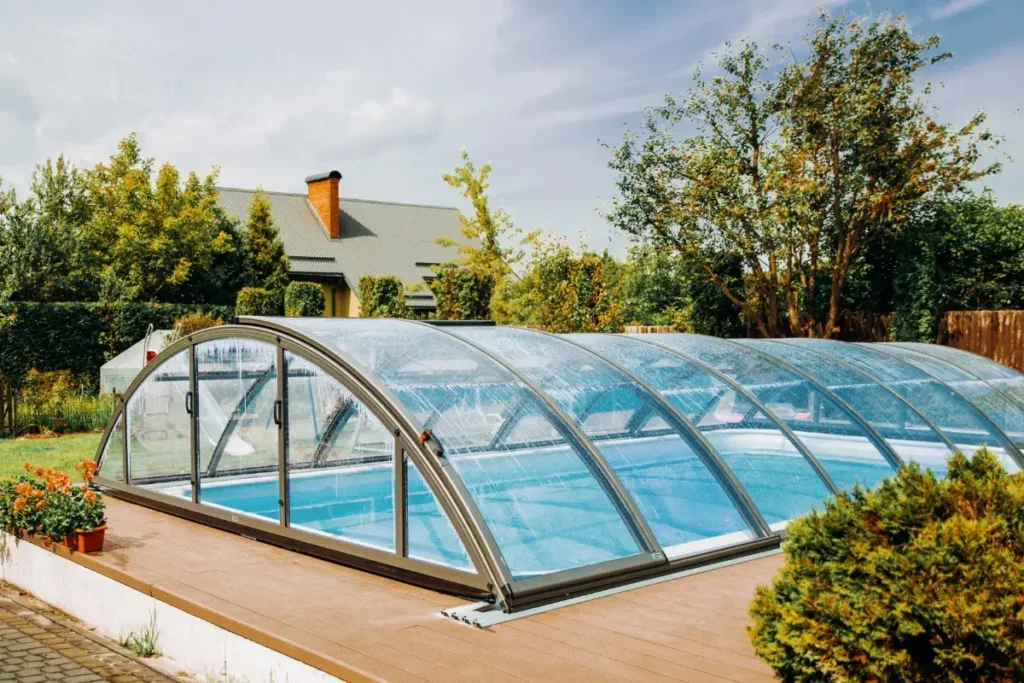
A swimming pool nestled in the garden, surrounded by trees and the joyful noise of children at play, often brings concerns such as dirty water or an open pool. A pool cover addresses multiple issues effectively.
As autumn approaches, the wind carries the first leaves, resulting in the need to scoop out wet debris repeatedly. With the pool temperature at 19 degrees Celsius, no one in the family is eager to swim. A pool cover changes this dynamic by reducing leaf accumulation, maintaining a pleasant water temperature, and keeping children and pets away from the water when closed.
Benefits of a Pool Cover
A garden is vibrant, and everything it sheds eventually finds its way into the pool. A cover captures leaves, pollen, and insects before they become a nuisance.
Moreover, a pool's operational costs can be significantly reduced. Approximately 70% of heat escapes from an open pool through evaporation. A cover retains heat, minimizes evaporation, and effectively extends the swimming season by several weeks.
This principle is similar to that of a greenhouse: sunlight passes through the transparent cover while warmth is trapped underneath. Over time, the water temperature can rise by 3 to 6 °C compared to an open pool, making it unnecessary to heat the water artificially.
Additionally, for families with children and pets, an open pool presents a safety hazard. A closed cover enhances security, preventing accidents.
Advantages at a Glance
- 🍃 Clean Water: Protection from leaves, pollen, and insects
- 🔥 Energy Savings: Up to 70% less heat loss overnight
- 💧 Reduced Evaporation: Up to 95% less water loss
- 📅 Extended Season: Swimming possible from April to October, with heating available beyond
- 🛟 Increased Safety: Child-safe systems prevent accidents
Overview of the Four Systems
Sliding Roof
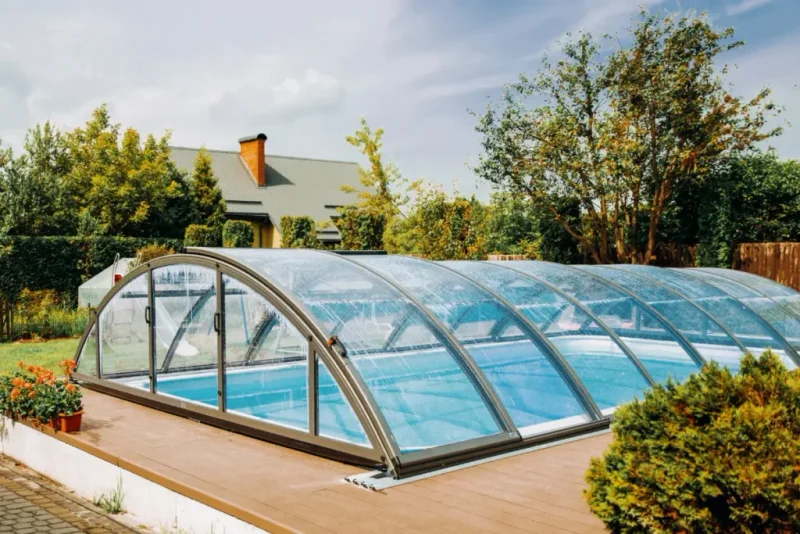
Sliding roofs consist of multiple segments that run on rails and telescope over one another. On sunny days, you can open the roof in minutes, while it remains closed during rain, allowing you to swim regardless of the weather. In the fall, the sliding roof can remain closed, collecting leaves on top instead of in the water, which can be swept away as needed.
💡 Tip: When collapsed, the segments rest at the pool's end, covering part of the water. A complete clear view of the pool is only achieved when the segments are parked beside the pool, requiring space beyond the pool's edge. This can be a challenge in smaller gardens.
Three Heights to Meet Different Needs:
- Low Covers offer a discreet and modern look, ideal for design pools, but swimming is not possible underneath.
- Medium Heights strike a balance between understated design and headroom, allowing comfortable access through a door at the front.
- High, Walkable Sliding Roofs provide maximum comfort, enabling swimming in the rain and upright movement around the pool's edge. This option is best for families who use their pool frequently year-round. However, consider the visual impact, as a structure over two meters tall can dominate the landscape like a greenhouse.
💰 Price Range: 1,500 to 5,000 € for low systems, 5,000 to 15,000 € for medium heights, and 15,000 to 40,000 € for high, walkable roofs.
💡 Expert Tip: Drainage channels along the rails keep water and debris out of the pathways. Clogged rails can hinder the entire mechanism.
Roller Cover
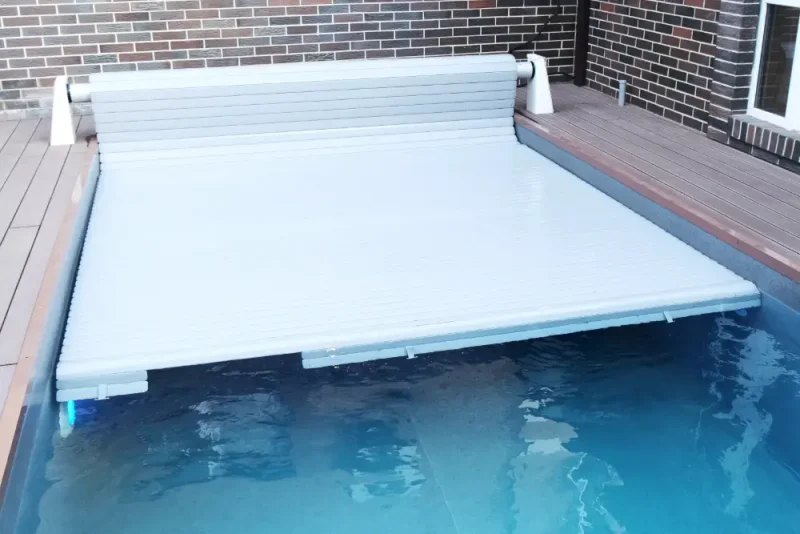
The roller cover is the most convenient and discreet option. With the press of a button, the slats glide over the pool, either mounted above or below the edge, without obstructing views of the garden.
💡 Tip: Walkable safety versions can support the weight of an adult. If a child runs onto the closed cover or a dog chases a ball, no one will fall in. For gardens that double as playgrounds, the extra cost for this tested model is worthwhile.
Two Mounting Options:
- Above-Ground Rollers are easy to install and provide reliable protection. The slat box sits visibly above the water level and can be cleverly disguised as a bench along the pool's edge. They can also be added later without hassle.
- In-Ground Rollers completely disappear into a pit at the pool's edge, offering a sleek, minimalist appearance. However, installation is more complex and is best suited for new constructions.
Material Choices Affect Durability and Benefits:
- PVC Slats are affordable and lightweight but less durable.
- Polycarbonate Slats are impact-resistant, hail-proof, and long-lasting.
- Solar Slats additionally heat the water using solar energy.
💰 Price Range: Starting from 4,800 € for small above-ground systems, 7,000 to 12,000 € for an 8 x 4 m pool, and 10,000 to 18,000 € for in-ground options.
Domes and Pavilions
Domes and pavilions are suitable for above-ground pools. These semi-spherical or oval pool covers made of plastic shield against rain and dirt while heating the water through the greenhouse effect. They can be set up within a day without construction and can be stored in the garden shed during the off-season. However, their lightweight design makes them more vulnerable to strong winds compared to more robust structures.

- Spacious pavilion: 600 x 295 cm
- Suitable for Bestway pools up to Ø 488 cm in diameter
- Quick setup in 30 minutes (2 people), featuring 2 entrances and 8 large transparent windows
- Outer tent: 190T polyester (2000 mm PU-coated) with UPF 50+ sun protection; inner tent: 190T polyester (3000 mm PA-coated)
- Contents: 1 pavilion, 1 carrying bag, 16 pegs
💰 Price Range: Simple domes for above-ground pools start at around 200 €, while sturdy domes and telescopic models for larger pools range from 1,200 to 3,500 €.
Tarps and Covers
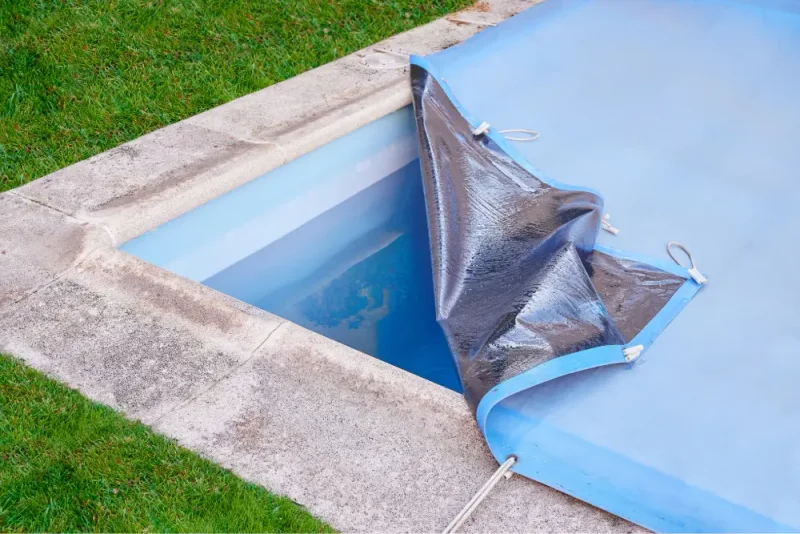
The simplest solution remains a cover placed directly on the water. A solar or bubble cover floats on the surface, collecting sunlight during the day and reducing heat loss at night. The cover must be removed for swimming, which is facilitated by a roller at the pool's edge. In winter, solar or bubble covers can be stored, and a solid cover can be placed over the pool.
While tarps and covers do not match the comfort and season extension of solid systems and are not suitable for child safety, they serve their purpose as an entry-level solution but require ample space.
💰 Price Range: 100 to 800 €.
Which System Fits Which Garden?
Your Situation
Suitable Solution
Large garden, nearby deciduous trees, year-round use
High sliding roof
Children and pets playing around the pool
Sliding roof, roller cover (walkable safety version)
Above-ground pool on the lawn, limited budget
Dome or pavilion
Small garden without space for parking
Roller cover or low sliding roof
Pure winter protection, entry-level solution
Cover with solar film
Key Questions Before Purchase
Do I have enough space around?
This is the most common pitfall. A sliding roof rests at the pool's end when collapsed, covering part of the water. If you want the pool completely free for swimming, a parking position beside it is necessary. This requires the rails to extend beyond the pool edge and needs a foundation, often where robotic mower cables and irrigation pipes are located. In smaller gardens, this can be a tight fit. A roller cover does not require this space, as its box sits on a narrow side. Therefore, check the pool's edge before deciding on a system.
What type of ground do I need?
Solid systems require stable, even, and frost-free ground. For sliding roofs, the rails must be laid on concrete or sturdy slabs and aligned precisely; even a slight deviation can hinder the segments. A dome can be secured on grass with ground spikes, while a tarp requires no groundwork. The simpler the system, the less preparation needed.
Can my pool stay outside all year round?
A solid roof can withstand winter but must bear the snow load of your region. In snowy areas, thicker polycarbonate is advisable instead of simple plastic. Lightweight domes and tarps should be removed before winter, as they cannot support much weight and are susceptible to strong winds.
Do I need an electrical connection?
Only for motorized systems. Roller covers and convenient sliding roofs operate at the push of a button and require a dedicated electrical circuit with an RCD, which is mandatory near water. A manual release is essential to ensure that the cover can be opened without power, preventing anyone from being trapped in front of a locked pool. Hand-operated systems, domes, and tarps do not require this setup.
Can I retrofit later, or must I plan during pool installation?
Above-ground roller covers, domes, and tarps can be added to an existing pool at any time. However, two elements must be considered during new construction: in-ground roller covers require a pit at the pool's edge, and large roofs need a foundation. Retrofitting these features can be labor-intensive.
What about the dripping water under the cover?
Under a closed roof or dome, steam from the pool rises, condensing on the panels and dripping back down, creating the notorious "drip cave." A solar cover on the water surface minimizes this problem by covering the area from which the steam rises.
Do I need a building permit?
Building regulations vary by state in Germany, so the answer will differ depending on your location. For the pool itself, in most regions, the threshold is 100 m³ of water volume; below this, the pool is often exempt from regulations. Some states have stricter limits, and specific rules apply to permanently anchored pools. Always refer to your state's building codes for clarity.
⚠️ Important Building without the necessary permits can lead to fines or require demolition and may cause issues when selling your home later. A quick call to your local building authority before planning can provide clarity and is free of charge.
Conclusion: An Investment That Pays Off
Investing in a pool cover enhances the comfort, energy efficiency, and longevity of your pool. Prices range from a simple tarp starting at 100 € to a walkable sliding roof costing up to 40,000 €. There is a solution for every garden and family lifestyle in between. Those who heat their pool can recoup part of the investment through savings on energy costs.