A Mythological Garden in Valencia
Explore a unique garden in Valencia inspired by Greek mythology, rooted in a historical misunderstanding regarding the Garden of the Hesperides.
Valencia is home to a unique garden inspired by Greek mythology, but intriguingly, its concept stems from a historical misunderstanding. The ancient Greeks believed in a mythical garden, known as the Garden of the Hesperides, located in the western lands, with some claiming it to be in Morocco and others in Spain. This garden was guarded by three nymphs—Egle, Eritea, and Hesperetusa—who protected golden apples that granted immortality.
According to the myth, the goddess Hera planted a branch gifted by Athena, which grew into the tree or trees bearing these golden apples. Hera, suspicious of the nymphs who occasionally took the apples, decided to add an extra layer of security by placing a ten-headed dragon to guard them.
Heracles, known as Hercules to the Romans, was tasked with stealing the apples as one of his twelve labors. He succeeded by slaying the dragon and outsmarting a deity, leading to the transformation of the nymphs into trees as punishment—one became a willow, another a poplar, and the third an elm. Ultimately, the apples were returned to Athena, who brought them back to the garden.
Years later, during the Renaissance, a cultural revival sparked interest in the Garden of the Hesperides. However, a mistake was made; someone conjectured that the strange golden fruits could not be apples, as Malus domestica lacks many varieties with golden hues. Scholars of the time mistakenly identified the fruit as citrus, hence the term "hesperidium" now associated with citrus fruits.
This misunderstanding paved the way for the creation of a mythological garden in Valencia, a region celebrated for its abundant and high-quality citrus crops.
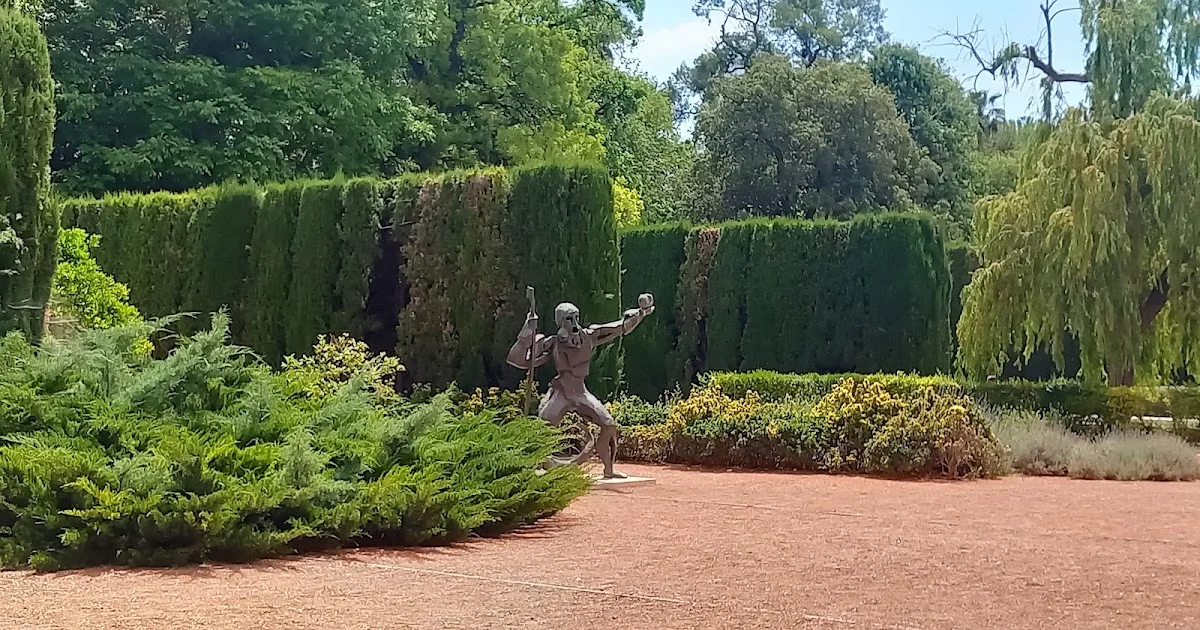
Located on nearly 5,000 square meters adjacent to the Botanical Garden of the University of Valencia, this enclosed garden features a collection of citrus trees, water features, and various statues. In a nod to the nymphs' transformation, the garden includes a Siberian elm (Ulmus pumila), a Lombardy poplar (Populus nigra 'italica'), and a weeping willow (Salix babylonica). Purists may argue that these species were not known to the ancient Greeks, yet the garden's creator clearly intended a playful reference.
Upon entering, visitors are greeted by a door adorned with a dragon guarding the garden. The space is rectangular, with a gently sloping area that descends towards the former riverbed of the Turia, bordered by strips of vegetation and large pots filled with a variety of citrus fruits (54 varieties), along with other species like cypress and ginkgo. A pergola draped with bougainvillea adds to the charm. A slight elevation on the opposite side of the entrance disrupts the flatness of the area, featuring a pond and small channels, complemented by a concrete floor imprinted with leaf patterns.
During a visit to Iberflora and the Botanical Garden of Valencia three years ago, I stumbled upon this garden. Last year, I returned without students and took the opportunity to explore it again. I noticed it appeared less well-maintained during my second visit, with fewer visitors and some litter, and I observed a few individuals attempting to pick lemons from the remaining trees. Additionally, the presence of numerous cats added a peculiar touch to the garden's atmosphere.
If you plan to visit Valencia, this garden offers a wonderful complement to the Botanical Garden and is free to enter.
Have you heard of this garden before? Until next time.