Freesia alba - Flowering Balcony - The Gardening Blog
An exploration of Freesia alba, its cultivation tips, and fascinating facts about this fragrant plant.
- by francescodiliddo
- article dated March 26, 2026
- No comments
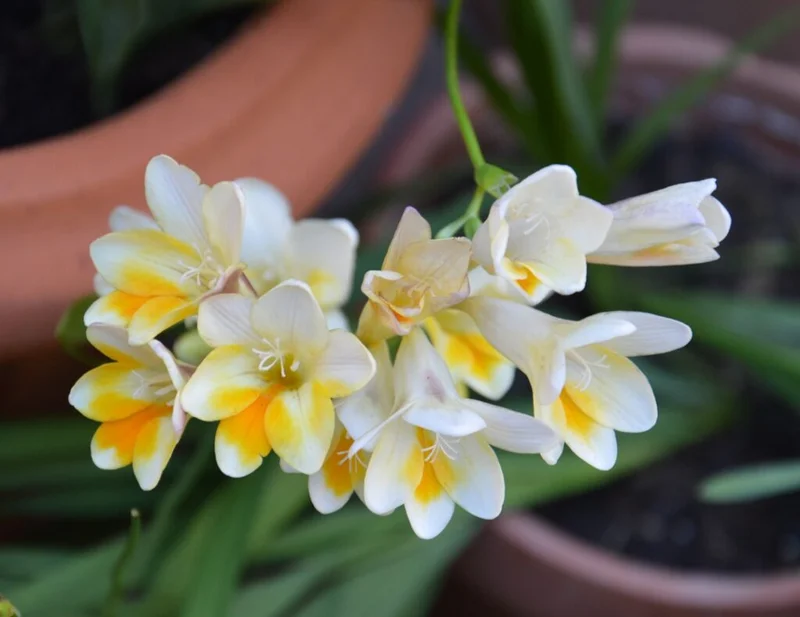
An indelible olfactory memory from my adolescence is the Freesia alba that I first smelled, with great astonishment, in the garden of an abandoned house in the countryside.
In the market, you can easily find hybrids with bright colors and larger flowers that do not have the same fragrance, and I must thank Flora Import Holland for giving me the small corms that I planted in a pot last October. I have been using freesias since 2013, and they are among the easiest bulbous plants to cultivate and are absolutely re-flowering. You can leave the corms in pots and flower beds, and they will bloom again every spring on their own. A touch of white color with an incredible fragrance, despite the flowers being small.
Below, I show you the fragrant blooming of these days on the terrace and, as usual, my tips and some curiosities. Have a good day, Francesco Diliddo.
Curiosities and tips for cultivating Freesia alba
The scientific name is Freesia leichtlinii subsp. alba, native to South Africa and belonging to the Iridaceae family. Its common name is White Freesia, famous for being considered the species of freesia with the most intense and sweet fragrance among all wild and hybrid varieties.
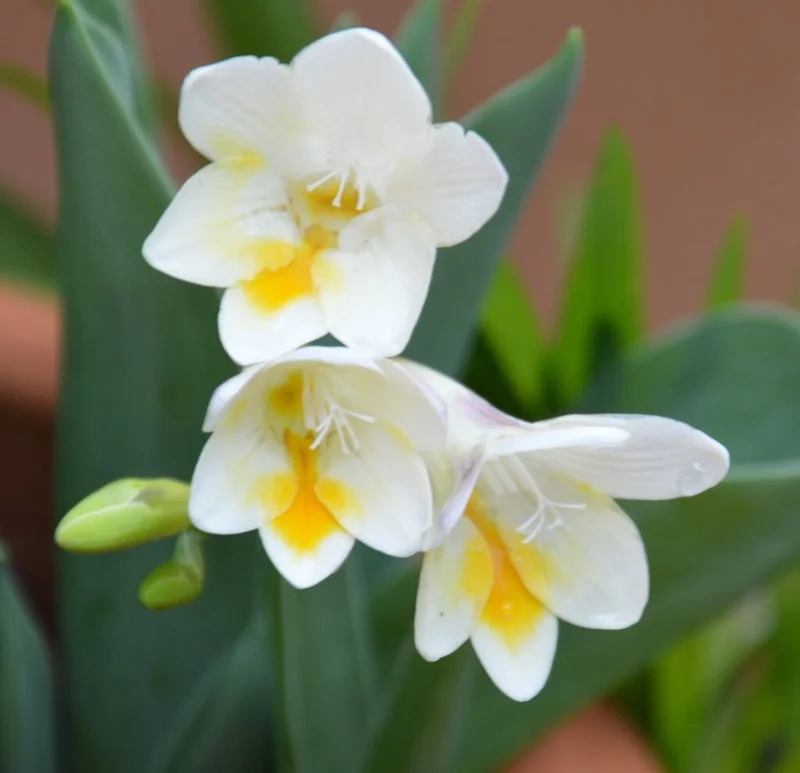
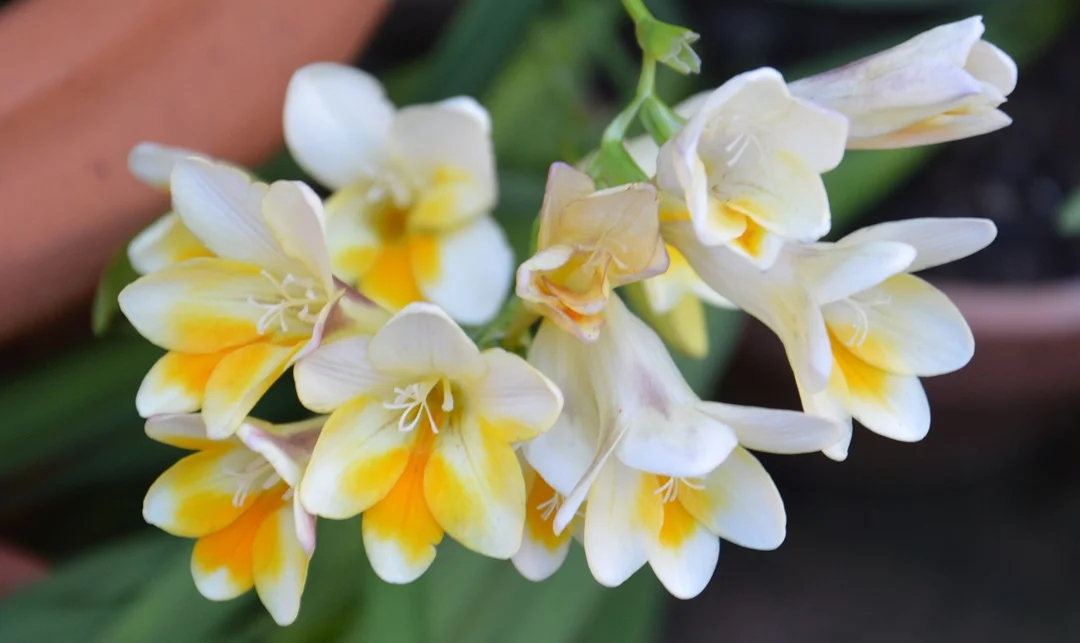
The Freesia alba is distinguished by its funnel-shaped flowers, which are cream-white with violet hues on the outside and a characteristic yellow spot in the throat.
A bulbous plant that does not exceed 30 centimeters in height, it features deciduous, linear, and lanceolate leaves of light green color, about 15 centimeters long.
The corms of Freesia alba are planted in autumn, adapt to any soil (preferably light and well-drained), and should be positioned with the tip facing upwards, burying them to a depth of about 5-8 centimeters. The distance between each corm should be about 5-10 centimeters to allow the roots to develop well.
After planting, the corms should be watered to compact the soil, and subsequently, the soil should be kept moist but not soaked until the first shoots appear.
For pot cultivation of Freesia alba, the container should be at least 20 centimeters deep with efficient drainage holes at the bottom.
The best exposure for cultivating Freesia alba is in fully sunny or partially shaded locations, and direct sunlight for a few hours a day is essential to promote bud development.
Let’s not forget the origin of Freesia alba, South Africa, which makes it not very frost-resistant. If temperatures drop below 10° C, it is advisable to grow it in a pot to protect it.
Curiosity
The etymology of Freesia derives from the German pharmacist Friedrich Heinrich Theodor Freese (1795-1876), who discovered this genus in South Africa, while leichtlinii was chosen in honor of the German botanist and horticulturist Maximilian Leichtlin (1831-1910), who was among the first to work on the hybridization of Freesia alba.