
Borage, Appreciated or Unknown?
Today we discuss a vegetable that has been consumed since ancient times, and in some places, forgotten or unknown. Borage is a resilient plant with various uses and benefits.
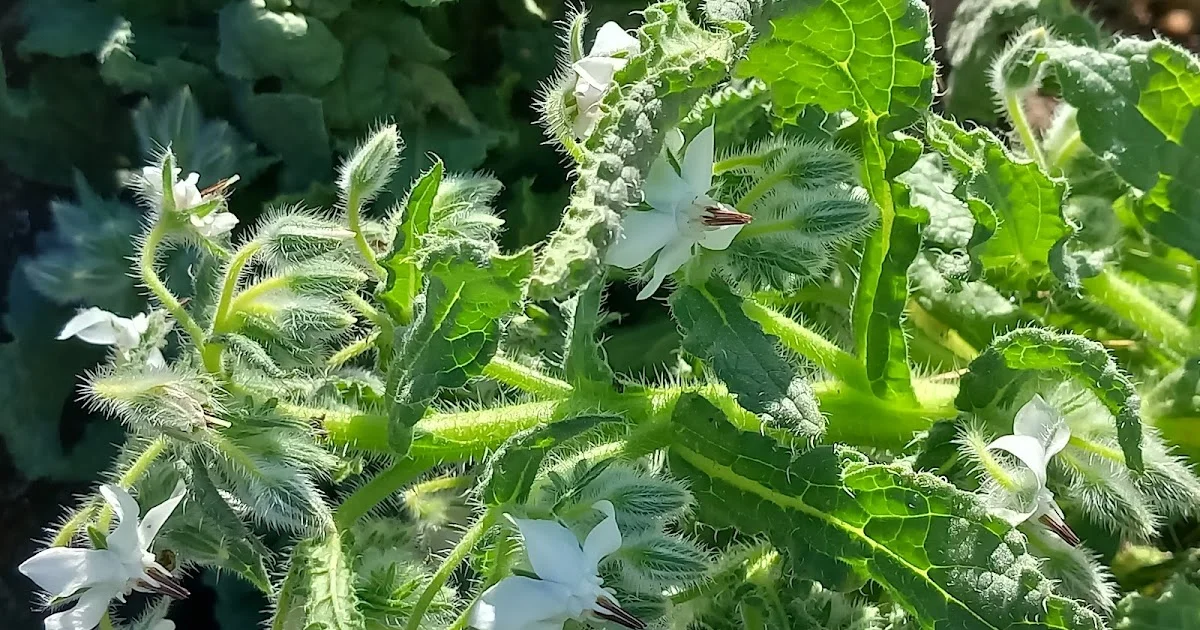

Today we talk about a vegetable that has been consumed since ancient times, and in some places, forgotten or unknown.
Talking about this plant undoubtedly brings back memories for many of their hometown, their home, and the stews from their parents' house... for others in Spain, it is something they only know through an expression. Today we discuss Borage, Borago officinalis, from the Boraginaceae family.
It is an annual plant that inhabits the Mediterranean region and the Near East. Borage specimens can reach and exceed half a meter in height, with oblong or oval leaves that are sessile (attached directly to the stem without a petiole). Its flowers are bluish or reddish, and as you can see in the photos, some are white (depending on the variety). The entire plant is covered with tiny hairs that can prick a little upon touch (this can vary by variety; those with white flowers usually have fewer hairs and less coarse leaves). Humans consume its leaves and stems (I understand that its flowers can also be consumed), always of course well cleaned of the hairs on the leaves, which would be bothersome to eat.

The Romans and Greeks already consumed this species. It has been used to manufacture explosives (due to its potassium nitrate content), to flavor alcoholic and non-alcoholic beverages, as a cosmetic, for magical symbolism, and for countless other uses. It has been used in medieval gardens as an ornamental plant and is a nectar-rich plant appreciated by insects.
Borage is a resilient and hardy plant that adapts well to a variety of soils. However, it prefers loamy or slightly clayey soils, with moisture (without waterlogging, as it does not tolerate drought well) and rich in organic matter. It tolerates shade but thrives better in sunlight, provided it is not scorched.


It has the problem of premature flowering, linked to cultivation cycles with sowings at low temperatures and the genetic predisposition of the cultivated variety. Generally, they are harvested before flowering, so bolting is bad news (unless for seed production).
The other major drawback is that they do not tolerate bare-root transplanting well, making direct sowing in the cultivation site preferable. However, considering their tendency to bolt, it will not be difficult to obtain seeds. In fact, they are often seen "naturalized" in rubble, edges of gardens, or old plots that are no longer cultivated... We will sow with a spacing of 30 x 30.
Borage is also valued for its various medicinal properties. Despite the expression "to end up in borage water" to say that something that generated high expectations ends up as nothing, Borage is a nutrient-rich plant and beneficial when consumed in moderation. It should be noted that it can cause allergic reactions in sensitive individuals upon ingestion or even touching it, so caution is advised when consuming it if we do not know how we might react to this species. Excessive consumption is not recommended as it can affect the liver.

It seems that its consumption is common in some regions of Spain while in others it is hardly known (either due to lack of tradition or abandonment of its cultivation), although I observe a resurgence, especially linked to the rise of urban gardens and similar initiatives, and also due to its increasing presence in restaurants rediscovering it for traditional or modern recipes.
They do not suffer from excessive diseases or pests, although snails and slugs, the ever-present aphids, and some fungi can affect them... We will avoid cultivating lettuce, escarole, or borage itself in the years before and after... this should be taken into account for crop rotations and successions.
Conversely, it may be interesting to associate the cultivation of Solanaceae (potato, tomato...), Cucurbitaceae (cucumber, pumpkin, zucchini...), Brassicaceae (like cabbage and broccoli), strawberries, or Liliaceae (onions, garlic, leeks).
To be honest, I understand they are a delicacy, but I have neither cultivated them nor know how to prepare them, nor have I consumed them or know any recipes for them. In my family's garden, in southwestern Asturias, they have never been cultivated, and in Palencia, I have hardly seen them for sale. Do you cultivate or eat them? I know they are more common and appreciated in other parts of Spain, as well as in other countries around us.
I look forward to your comments.