Musa acuminata 'Dwarf Cavendish' - Balcony Gardening
An article about the Musa acuminata 'Dwarf Cavendish', a popular ornamental banana plant, including cultivation tips and care instructions.
- by francescodiliddo
- article dated April 29, 2026
- No comments
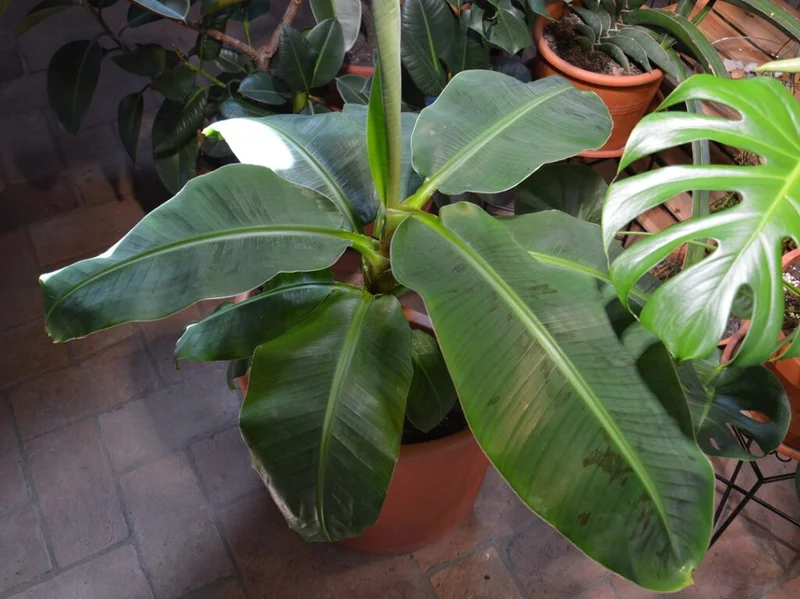
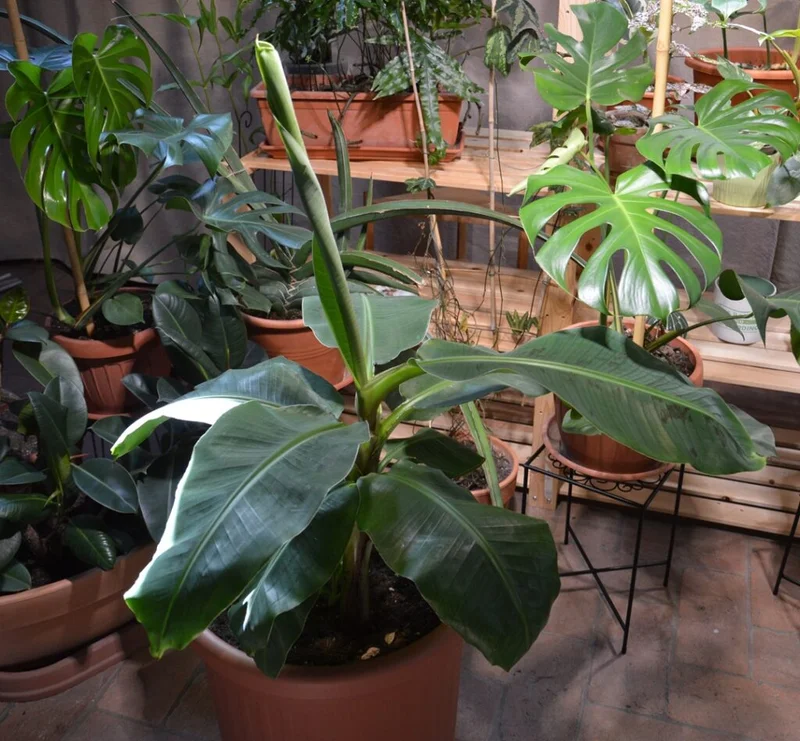
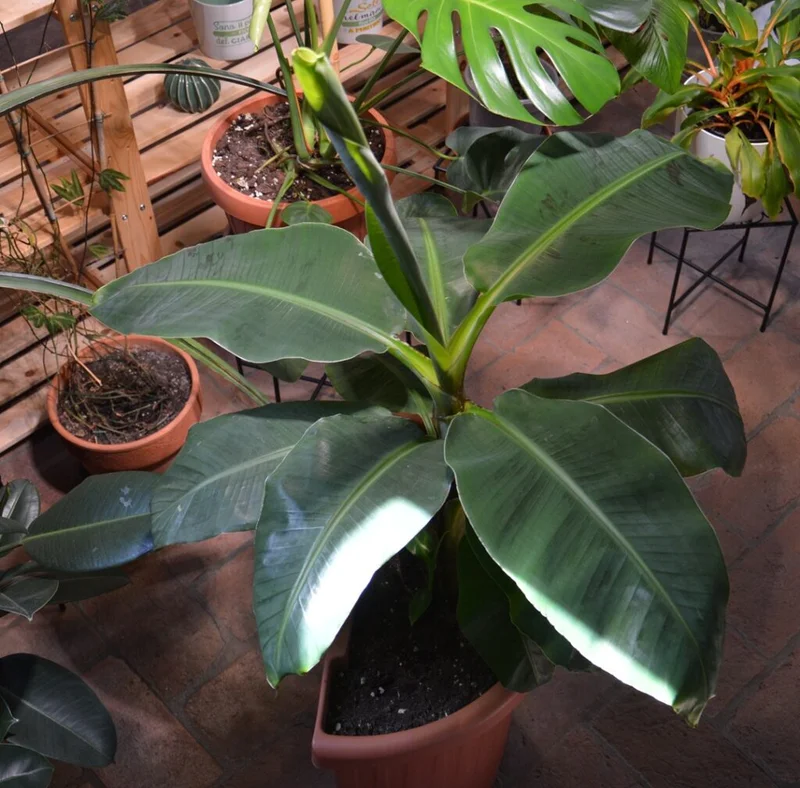
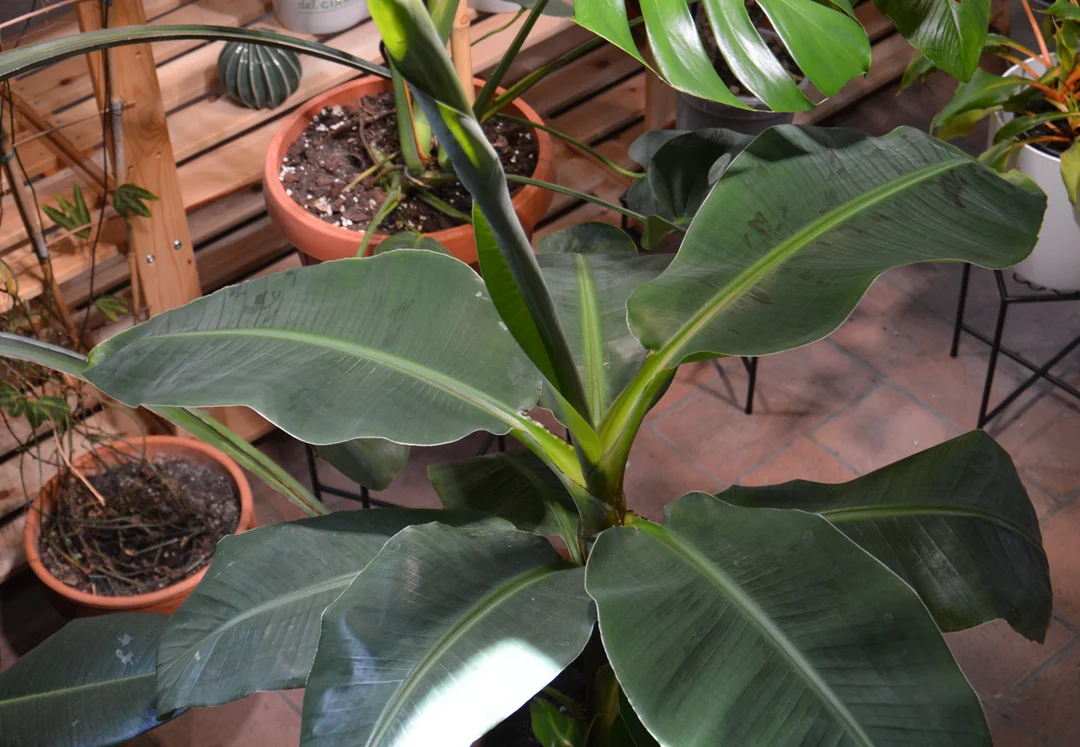
The ‘Dwarf Cavendish’ banana is a cultivar (hybrid) of Cavendish that I stumbled upon at the supermarket (super affordable price) last winter.
Once home (its scientific name is Musa acuminata ‘Dwarf Cavendish’), I repotted it in a nice deep pot, it grows very quickly, adding an exotic touch to my attic, and as soon as the minimum temperatures rise a bit (above 10° C), I will move it to the terrace. The name ‘Dwarf Cavendish’ refers to the height of the pseudostem, not the fruit, and young plants have brown or purple spots on their leaves, but they quickly lose these as they mature: indeed, as you can see from the photographs, they have almost completely disappeared. Below, I share my cultivation tips, some curiosities, and wish you a good day, Francesco Diliddo.
Curiosities and Cultivation Tips for Musa acuminata ‘Dwarf Cavendish’
The Musa acuminata ‘Dwarf Cavendish’ is a hybrid belonging to the Musaceae family and has become one of the most beloved ornamental plants in the world due to its compact stature, which rarely exceeds 2-3 meters, and its extraordinary ability to adapt to life in pots. In fact, unlike its giant cousins, the Musa ‘Dwarf Cavendish’ is robust and compact. It is characterized by large, vibrant green leaves, which in young specimens often display elegant brown or burgundy spots that fade with growth, and it is an herbaceous plant, not a tree; indeed, the trunk is actually a pseudostem made up of overlapping leaf sheaths.
The first secret to lush growth is exposure, and being native to Southeast Asia, it loves the sun and needs at least 6-8 hours of direct sunlight per day. If grown indoors, the ideal position is in front of a south-facing window, where the rays can reach it unobstructed. In my attic, I used grow lights in winter, and now it is positioned under a skylight!
Regarding temperature, the Musa ‘Dwarf Cavendish’ loves consistent warmth due to its tropical origin, and the ideal temperature ranges between 18° and 28° C. In winter, it tolerates brief periods of cold, but if the temperature drops below 10° C, growth stops abruptly. Below 0° C, the plant risks dying, so in very cold climates, it should be moved indoors.
For watering and humidity, it is essential to find the right balance: since the Musa acuminata ‘Dwarf Cavendish’ has large leaves that transpire a lot of moisture, it becomes a particularly thirsty plant that despises waterlogging, which can rot its rhizome. In summer, it should be watered generously whenever the top inch of soil feels dry to the touch, while in winter, watering should be drastically reduced, keeping the soil only slightly moist.
Ambient humidity is very important for the Musa acuminata ‘Dwarf Cavendish’: in apartments, dry air from heating can dry out the leaf edges, so it is essential to regularly mist the foliage with non-calcareous water or use a humidifier.
To support its rapid growth, the Musa ‘Dwarf Cavendish’ requires nutrient-rich and well-draining soil, and its ideal mix consists of high-quality potting soil, peat, and a good handful of perlite or pumice to promote water drainage.
For large, glossy, and decorative leaves, fertilization is crucial, especially during the growing season (spring-summer); a balanced liquid fertilizer (NPK 20-20-20) should be administered every two weeks.
One curiosity about the leaves of the Musa ‘Dwarf Cavendish’ is that they are delicate and can tear easily if exposed to strong winds or drafts: this is a natural phenomenon called ‘fraying’ that does not harm the health of the plant. It is a natural process of tearing the leaf blade, which splits along the transverse veins. This phenomenon is a biological adaptation of the banana plant.
The banana can be attacked by mites, and to keep them away, simply wet the leaves in the evening, as these red spiders dislike humidity: in the case of a significant infestation, the plant can be treated with an acaricide.