
Abundant Blooming, Duranta
If you live in a mild climate without frost or very light frosts, you should consider it for your patio or garden. Duranta erecta is a shrub that can exceed 5 meters and blooms abundantly from early spring to late summer.
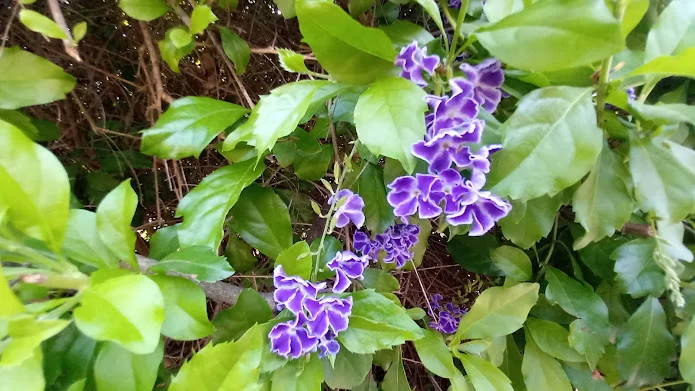

If you live in a mild climate without frost or with very light frosts, you should consider it for your patio or garden.
From the family of Verbenaceae and of American origin, Duranta erecta is a shrub that can exceed 5 meters without much difficulty. It has simple leaves, medium green/yellowish in color (there are also variegated varieties), shiny, with opposite arrangement on the branches. When it grows, many branches end up "hanging," giving a pendulous appearance to the specimen. Importantly, they are perennials. This is not a trivial detail if we want to use this species as a hedge. If it weren't for its flowering, it would pass as a green "filler" plant; it is its flowers that create that interest. It blooms abundantly from early spring to late summer with purple flowers, but there are countless cultivars ranging from white, lilac, blue, to white-edged... These flowers are fragrant, and some say they remind them of chocolate to spices... Once fertilized, the flowers develop into small yellow fruits, about the size of chickpeas (one of its vernacular names), which can also be interesting from an aesthetic point of view.

Duranta is a plant that appreciates exposure to sunlight; it thrives well in warm climates without frost or with light, short-duration frosts. It does not like waterlogged soils, but we also shouldn't force it to suffer from excessive drought. We will look for loose, nutrient-rich soils.
It tolerates locations near the coast, which is always of interest in an environment where many plants suffer from the effects of salt.
It can be pruned to control its shape. Additionally, it is a plant that hardly suffers from pests and diseases.
This plant can be used in large pots or directly in the ground, always considering the climate as we have mentioned. It can be placed in a composition with other shrubs, hanging in an area with a slope, or as a perimeter hedge.


Although very attractive and aromatic (it attracts pollinators), it is a poisonous plant, and care should be taken to prevent poisoning of children and pets. Conversely, from what I am reading, birds consume it without suffering from poisoning. In some places, its abundance of fruits and the dispersion of seeds by birds have led it to be considered invasive. In Spain, for the moment, the Ministry of the Environment does not include it in its list of invasive species. Let’s add that it is also easy to propagate by cuttings...
I leave you with some photos I took in the Turia Gardens in Valencia, where, as you can see, Duranta erecta grows very well.