
The Invisible Boundary of Earth: Why No Hurricane Can Cross the Equator
Hurricanes are among the most powerful natural phenomena on Earth, but they cannot cross the equator due to the Coriolis effect.
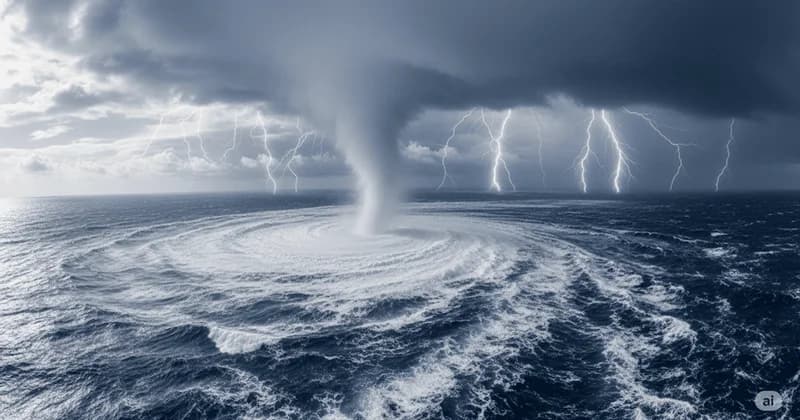
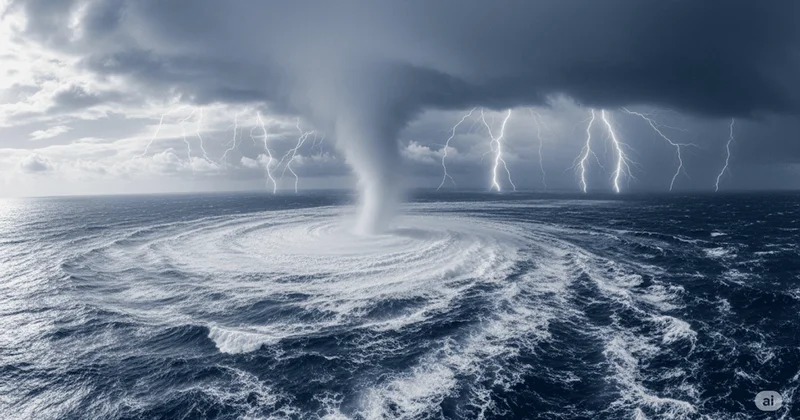
Hurricanes are among the most powerful natural phenomena on the planet. They can cover vast areas, causing destructive winds, heavy rains, and floods. However, even such massive storms have limitations: they practically do not approach the equator and never cross it. Scientists explain that the reason lies not in a lack of energy but in the unique workings of Earth's atmosphere.
This was reported by Iflscience.
Experts remind us that hurricanes, typhoons, and cyclones are all the same type of tropical storm. The difference lies only in the name, which depends on the region. They are called hurricanes in the North Atlantic and the northeastern part of the Pacific Ocean, typhoons in the western part of the Pacific Ocean, and cyclones in the Indian Ocean.
These storms typically form over tropical seas where the water temperature exceeds 26°C. The warm sea heats the air above the surface, causing it to rise and cool, forming clouds and thunderstorms. In the lower layers of the atmosphere, a low-pressure zone forms, into which new air begins to flow.
The further development of the storm is influenced by the Coriolis force—an effect related to the rotation of the Earth. It determines the direction of air mass rotation. In the Northern Hemisphere, hurricanes rotate counterclockwise, while in the Southern Hemisphere, they rotate clockwise.
At the same time, near the equator, the Coriolis force is absent. Because of this, atmospheric systems do not receive the necessary rotation to transform into a hurricane. This is why such storms rarely occur closer than 300 kilometers from the equator.
One of the exceptions was Typhoon Vamei, recorded in 2003 approximately 150 kilometers north of the equator. However, researchers note that similar cases are extremely rare.
This feature also explains why hurricanes cannot cross the equator. For this to happen, the storm would have to pass through a zone without the influence of the Coriolis force and then change its rotation direction to the opposite. Because of this, the equator remains a natural boundary that tropical cyclones cannot overcome.
It is worth noting that earlier research by American scientists clearly linked the melting of permafrost in Alaska to the catastrophic orange coloring of local rivers, which, due to toxic iron content, threatens to destroy the entire aquatic ecosystem.