
In Gardening, at Least Since the Middle Ages
Today we discuss a well-known Boraginaceae, the Comfrey or Greater Comfrey (_Symphytum officinale_), a plant used in gardening since the European Middle Ages.

Today we talk about a well-known Boraginaceae, or perhaps not so much...
The Comfrey or Greater Comfrey
Symphytum officinale
is a plant that has been used in gardening since the European Middle Ages. Today, far from a vague and uninteresting memory, it is still very interesting to have it in our gardens or plots.
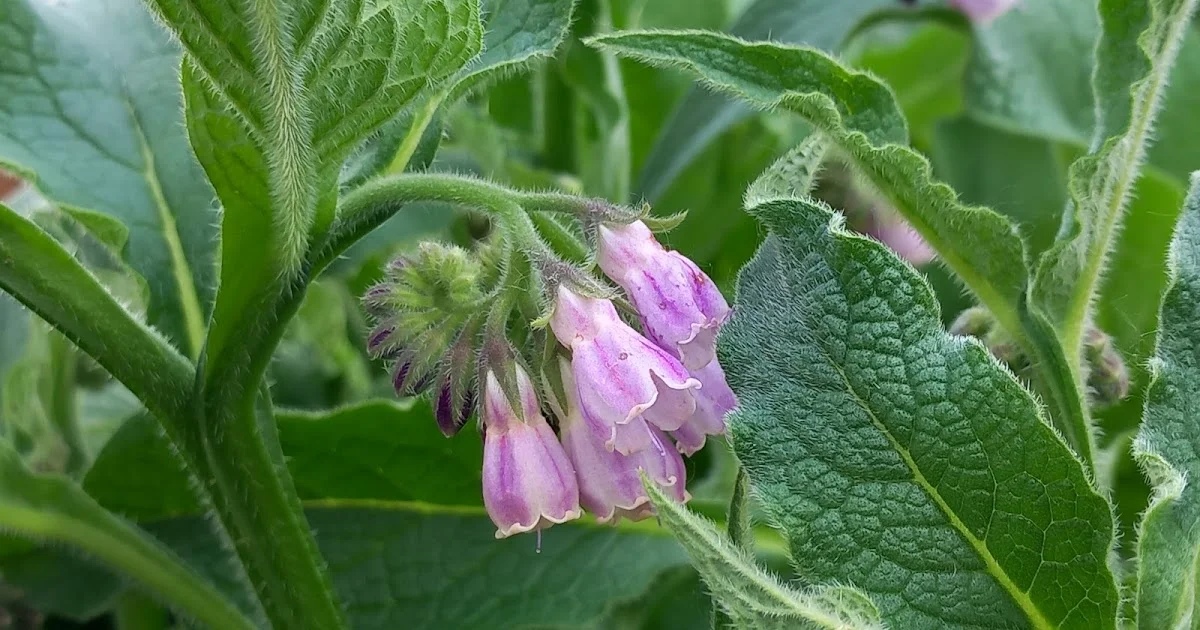
It is a perennial herb that can reach heights of up to 1m or 1.5m, or even more, with strong stems covered in hair, forming large and compact clumps. Its leaves are large and oval-lanceolate in shape. The largest leaves (20cm or more in length) located at the base have petioles. They have a rough appearance with marked veins. The flowers appear in cymose inflorescences that crown the tips of the stems. The flowers can be pink, purple, or whitish. There is a variety with variegated leaves that is interesting in gardening. These plants have a powerful root system and can live for many years (losing their leaves if the cold is severe) and sprouting again in spring thanks to the reserves accumulated in their roots.

Comfrey Symphytum officinale clumps
This plant originates from Central Europe and extends its natural distribution to Turkey. It withstands cold well, thanks to its root system, and also tolerates drought relatively well. However, it prefers rich, moist, and well-drained soils. It is tolerant of different soil types and locations, always ensuring that if our plot enjoys a warm climate, it is better to place it in partial shade to protect it from the sun. In Castilla y León, I have seen it thriving both in full sun and in partial shade, even too well (almost becoming an invasive plant along stream banks and in gardens...)
It is a plant known for its multiple medicinal properties. It is recommended not to ingest it and to apply it only externally, as it contains toxic substances that can harm health if consumed regularly. However, in this entry, we will focus on its ornamental uses and for the vegetable garden.

Comfrey flowers
It is a plant that grows compactly and fits well into any composition, giving that wild look that is so sought after in garden design today. Its flowers also attract a multitude of pollinators.
As for the vegetable garden, it is more than interesting because its deep roots "extract" nutrients from deep layers, which, when dying or mulching with its leaves (it grows vigorously, allowing us to remove some of the vegetation), serve to nourish the garden or vegetable plot.
With Comfrey leaves, rich potassium and nitrogen teas can be made, stimulating composting as they help activate the decomposition processes of organic matter. They serve as "easy" mulch to prepare, in addition to the virtues already mentioned.
It is not sensitive to pests or diseases, and it is easy to propagate by seeds or division of clumps... who could ask for more?

I must say that despite being a plant used since ancient times, I had not come across any specimens for a long time. Until relatively recently, by chance, and doubting whether I was facing this species... my students from the INEA foundation clarified my doubts. I had not noticed the quantity and vigor with which they grow along the margins of the gardens available to the people of Valladolid in their facilities. It is clear that the gardeners and trainers of the entity (professionals with great experience) know its value.
Unfortunately, in a world dominated by the chemical market (fertilizers, pest control...), it seems that Comfrey has lost its "presence." Nevertheless, with the rise of cultivating vegetable gardens, many people practice integrated or directly organic control of their crops, and it is in these places where it makes sense to have some Comfrey clumps in any corner of the vegetable garden or garden.
Did you know about this plant? I look forward to your comments.
Until next week.