
And Suddenly ...Physocarpus
I have gone from only seeing this shrub in photos to encountering it face to face 4 times in two different countries last summer. The first time I was aware of it was in a garden in the south of France near Dax.
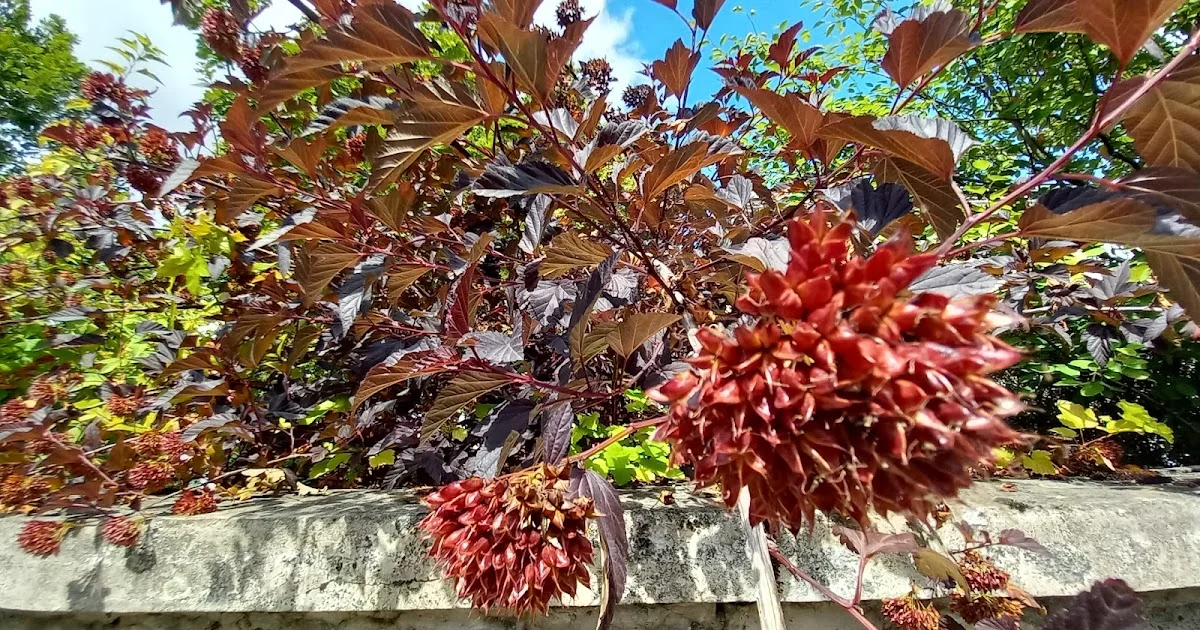

I have gone from only seeing this shrub in photos to encountering it face to face 4 times in two different countries last summer... The first time I was aware of it was in a garden in the south of France near Dax, in Bordeaux, and shortly after in Asturias in Aviles and in La Barrosa, the garden of my dear J Antonio, (click here to see the post I made after visiting his garden).
This is a deciduous shrub from the Rosaceae family, known as Physocarpus opulifolius, due to its leaves resembling the well-known Viburnum opulus.
It is a globular shrub with branches that tend to droop, and the crown is compact. It can reach several meters in height and width, acquiring a globular shape. Its bark has a cracked or fissured appearance, which has given it the curious common name of ninebark. Its leaves are lobed with serrated edges of an intermediate green tone, although there are varieties with reddish or yellowish hues... At the beginning of summer, it produces corymbs of small white (or slightly pink) flowers, which after fertilization will turn into small fruits of red/wine colors.

Physocarpus opulifolius
It is a vigorous and resilient plant, although it prefers full sun exposure (unless in a climate where the sun is too intense) or partial shade, in preferably acidic soils (although it adapts to various terrains), deep well-drained but moist soils, as they naturally come from environments near streams, ponds... in North America. It withstands frost well.


Physocarpus opulifolius
Regarding pruning, it is not very necessary, beyond controlling excessive growth, renewing the plant with a drastic pruning, or removing old or damaged dry branches.
It can be propagated by cuttings or layering, yielding clones of the mother plant ensuring the homogeneity of the offspring. Reproduction by seed provides genetic diversity but makes the "offspring" heterogeneous and they do not necessarily retain the characteristics of the mother plant.
It is a plant that attracts many insects, ideal for those who care about these aspects in their gardens.


Its tendency to "droop" makes it ideal for uneven terrain, Physocarpus opulifolius
Both in pots, or better yet, in the ground, they can give an interesting look to the composition. A single shrub of this species with some striking variety of golden or reddish leaves can stand out alone, combined in an informal hedge with other shrubs where it can grow freely. Providing structure and color. It can be an interesting focal point or combined in monochromatic gardens. Due to its drooping habit and its natural preferences, it can be placed at the edges of a pond or stream in the garden. I see it more in informal/landscape style compositions where it grows freely than in classic and formal gardens, but I wouldn’t rule it out... I have some ideas on where to fit it in. In gardens with different levels or heights, it can soften a slope or emphasize terracing by "drooping" towards the lower area.
I hope J Antonio can tell us a bit more in the comments about how it behaves in his Asturian garden. And I also encourage the rest of the readers to share their experiences with this species.
See you next week!